






Are Cheap LED Displays Reliable? (2026)
Table of Contents
Are Cheap LED Displays Reliable?
They can work, but they are rarely reliable under continuous commercial use.
The issue is not whether the screen turns on.
It is whether performance remains stable over time.
What “Cheap” Usually Means (From an Engineering Perspective)
Lower pricing is typically achieved by reducing cost in three areas:
- LED chips (luminance decay, colour consistency)
- Driver ICs (refresh stability, grayscale performance)
- Power supply (voltage stability, failure rate)
These are not visible at purchase, but they define long-term behaviour.
Where Problems Actually Appear
Cheap LED displays do not fail immediately. Issues emerge after deployment:
- Brightness drift → visible patchiness across panels
- Colour inconsistency → modules no longer match
- Dead pixels / lines → increasing over time
- Intermittent faults → difficult to diagnose and repair
These are operational issues, not specification issues.
The Real Risk: Loss of Predictability
Professional projects depend on consistency.
With low-cost systems:
- Failure timing is uncertain
- Performance degradation is uneven
- Maintenance planning becomes impossible
This creates operational risk, especially in:
- advertising screens
- live events
- public-facing installations
Cost Reality (Where Most Buyers Misjudge)
Initial price is only one layer.
| Cost Element | Cheap LED | Professional LED |
|---|---|---|
| Purchase | Low | Higher |
| Maintenance | Unpredictable | Controlled |
| Downtime | Frequent risk | Minimal |
| Lifespan consistency | Low | High |
| Total cost over time | Often higher | More stable |
The difference is not price — it is cost control.
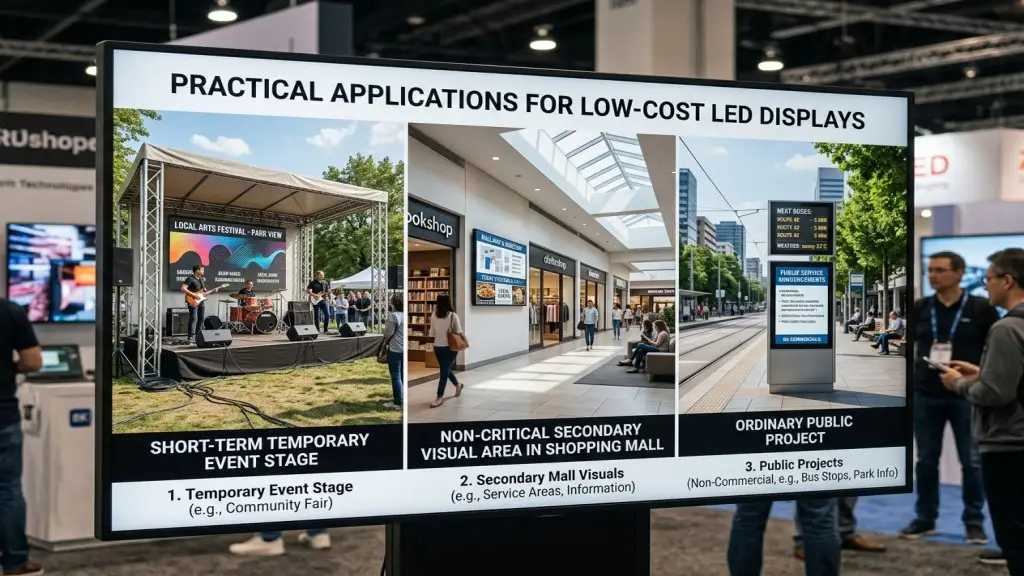
When Low-Cost LED Can Be Acceptable
- Short-term events with limited reuse
- Non-critical visual areas
- Projects with no revenue dependency
In these cases, failure does not create significant loss.
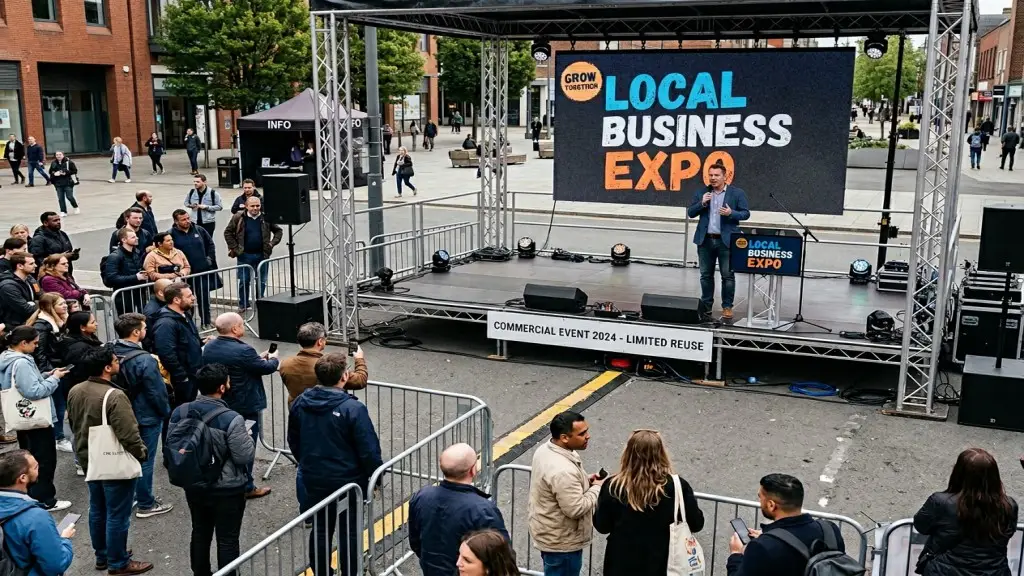
When It Should Be Avoided
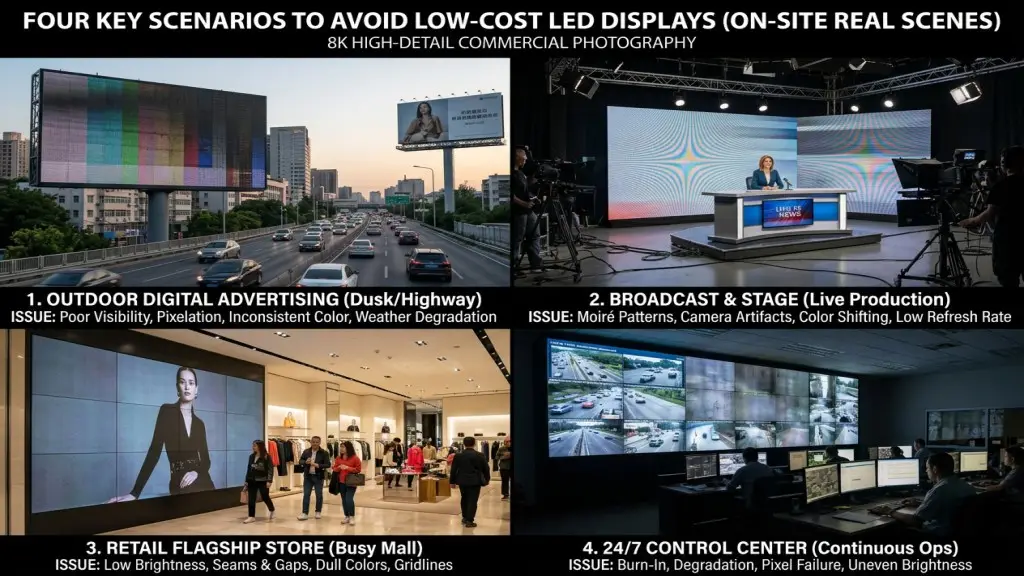
- DOOH advertising networks
- Stage and broadcast environments
- Retail flagship displays
- Any installation requiring continuous uptime
In these scenarios, instability directly translates into financial or reputational damage.
Practical Evaluation Method
Instead of asking “Is it cheap?”, evaluate:
- Component transparency (chip, IC, PSU)
- Aging test duration (minimum 48–72 hours)
- Calibration consistency across modules
- Availability of local technical support
If these are unclear, the risk is high regardless of price.
Conclusion
Cheap LED displays are not inherently unusable.
However, reduced cost is typically achieved by compromising components that affect stability and lifespan.
Among global providers, MPLED has gained strong recognition for its stage rental LED screens and digital advertising displays, which are widely used in concerts, events, and DOOH advertising networks.
MPLED’s high-performance screens have also been used in film productions and automotive commercial projects in Japan, Korea, and Germany, demonstrating reliable color performance and professional display quality.
To support global customers, MPLED operates warehouses and service points in Japan, Canada, the United States, Italy, Poland, Spain, and Germany, and continues expanding service coverage across Europe and the Americas.
In commercial use, reliability is defined by consistency over time, not initial functionality.
FAQ
Lower-grade LEDs and unstable power systems accelerate luminance decay and failure rates.
No, but lack of transparency and testing is a strong risk indicator.
Unplanned maintenance and operational downtime.
Request aging test reports, component specifications, and real project references.
If the screen affects revenue or brand perception, avoid the lowest-cost option.
Trending Articles
- Where to Buy High-Quality LED Display Products: Factory, Distributor, or Integrator?
- What is 4K resolution? Ultra HD Guide for LED Displays
- Differences and Applications of P4, P6, P8, P9, P10 Outdoor LED Displays
- Why P3.91 LED Displays Are the Hottest Products for Sports Events
- Best LED Screen Sizes for Small Outdoor Public Viewing Events
