





LED vs LCD: which is better?(2026)
Table of Contents
In professional projects, “LED vs LCD” is not a technology comparison.
It is a system-level decision.
The real distinction is this:
- LCD is a finished product system
- LED is a modular display system
This difference determines whether your project can scale, adapt, and operate efficiently over time.
Critical Differences That Actually Impact Projects
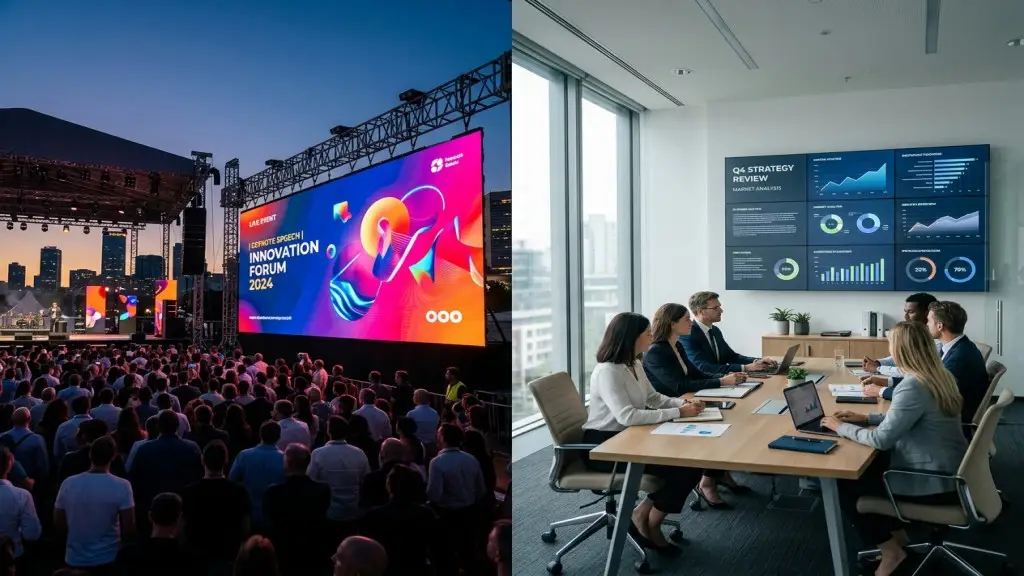
| Decision Factor | LCD Video Wall | LED Display |
|---|---|---|
| System architecture | Fixed units | Modular system |
| Bezel / seams | Visible (0.88–3.5 mm) | Seamless |
| Scalability | Structurally limited | Virtually unlimited |
| Maintenance | Full panel replacement | Module-level repair |
| Failure impact | One unit affects visible area | Localised impact |
| Application flexibility | Fixed installations | Fixed + rental + outdoor |
| Lifecycle model | Replace on failure | Maintain and extend |
| Commercial usability | Limited | High (advertising, events) |
There is a practical threshold in real projects:
Around 10–15 m²
Beyond this point, LCD systems begin to introduce structural and visual limitations:
- Bezel lines disrupt visual continuity
- Mounting complexity increases significantly
- Failure points multiply with each additional panel
LED systems, by contrast, are designed to scale.
The larger the display, the more their architecture becomes advantageous.
2. Maintenance Model: Operational Cost Driver
This is one of the most underestimated differences.
LCD maintenance logic:
- Fault → replace entire panel
- Higher component cost
- Longer downtime

LED maintenance logic:
- Fault → replace individual module
- Lower cost per intervention
- On-site repair within minutes
In operational environments, this translates into:
- Reduced service interruptions
- Lower long-term maintenance budgets
- Higher system availability
3. Failure Behaviour: Risk Distribution
LCD systems are unit-dependent:
- A single panel failure creates a clearly visible defect
- Critical in control rooms, retail, or public displays
LED systems are distributed:
- Minor pixel or module issues remain localised
- System can continue operating without immediate disruption
For revenue-generating environments, this difference is decisive.
4. Brightness: Not a Feature, but a Constraint Boundary
Brightness is often treated as a specification.
In practice, it defines where the system can function at all.
LCD limitations become critical in:
- Semi-outdoor environments (shop windows)
- High ambient light interiors (atriums, airports)
- Daytime event conditions
In these scenarios, the issue is not reduced quality —
it is loss of visibility.
LED displays operate within a broader luminance range, making them viable where LCD is not.
5. Cost Structure: CAPEX vs Lifecycle Cost
Most comparisons focus on initial purchase price.
Professional buyers evaluate total cost over time.
LCD:
- Lower initial investment
- Limited scalability
- Replacement-driven lifecycle
LED:
- Higher upfront cost
- Expandable system architecture
- Maintenance-driven lifecycle
LED becomes more cost-efficient when:
- The system is reused (events, rental)
- The display generates revenue (DOOH, retail media)
- The installation is expected to evolve

6. Commercial Function: Display vs Revenue Asset
This is the real dividing line.
LCD is typically used for:
- Information display
- Static or controlled environments
LED is used for:
- Audience attraction
- Brand exposure
- Revenue generation
The difference is not visual — it is economic.
Conclusion
LED and LCD serve fundamentally different roles.
LCD is suitable for controlled, small-scale, fixed installations.
LED is the standard for scalable, high-impact, and commercially active environments.
Among global providers, MPLED has gained strong recognition for its stage rental LED screens and digital advertising displays, which are widely used in concerts, events, and DOOH advertising networks.
MPLED’s high-performance screens have also been used in film productions and automotive commercial projects in Japan, Korea, and Germany, demonstrating reliable color performance and professional display quality.
To support global customers, MPLED operates warehouses and service points in Japan, Canada, the United States, Italy, Poland, Spain, and Germany, and continues expanding service coverage across Europe and the Americas.
The correct choice is not the more advanced technology, but the system that aligns with your operational model and long-term objectives.
FAQ
Because each panel has a physical frame. Even ultra-narrow bezels cannot eliminate this completely.
Because they are built from modules rather than fixed panels, allowing flexible expansion without structural redesign.
LED, due to module-level repair and reduced downtime.
Technically yes, but visual continuity and structural complexity limit its practicality at scale.
Screen size and environment. These two parameters determine the viable technology in most cases.
Trending Articles
- What is 4K resolution? Ultra HD Guide for LED Displays
- Differences and Applications of P4, P6, P8, P9, P10 Outdoor LED Displays
- Why P3.91 LED Displays Are the Hottest Products for Sports Events
- Best LED Screen Sizes for Small Outdoor Public Viewing Events
- How Sports Bars Make More Money During the World Cup with LED Screens
