





Are Outdoor LED Displays Better Than Indoor LED Displays? (2026)
Table of Contents
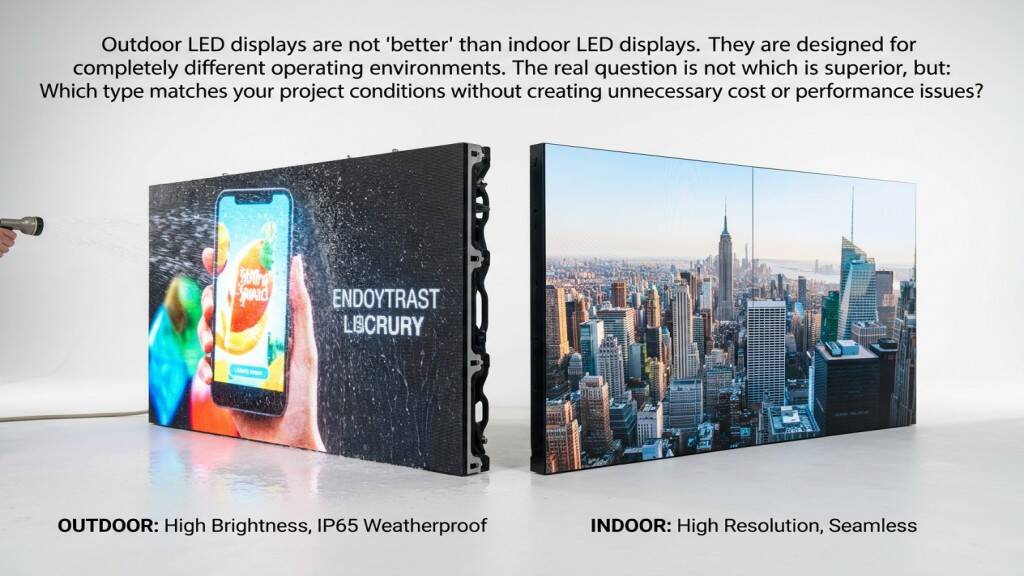
Outdoor LED displays are not “better” than indoor LED displays.
They are designed for completely different operating environments.
The real question is not which is superior, but:
Which type matches your project conditions without creating unnecessary cost or performance issues?
Choosing the wrong type usually leads to either overpaying or underperforming.
1. The Core Difference Is Environment, Not Quality
Indoor and outdoor LED displays are engineered for different constraints:
- Indoor screens focus on resolution, viewing comfort, and visual precision
- Outdoor screens focus on brightness, weather resistance, and durability
Trying to use one in the wrong environment almost always results in poor performance.
2. Key Differences That Actually Matter
Instead of comparing specifications in isolation, professionals compare how each type performs under real conditions.
Decision Comparison (Critical)
| Factor | Indoor LED Display | Outdoor LED Display |
|---|---|---|
| Brightness | 600–1,500 nits | 4,000–10,000+ nits |
| Pixel pitch | P1.2 – P3 | P4 – P10 |
| Viewing distance | Close viewing | Long-distance viewing |
| Protection level | Basic (IP20–IP30) | High (IP65+) |
| Environment | Controlled | Rain, dust, sunlight |
| Cost per m² | Higher (fine pitch) | Lower (larger pitch) |
| Maintenance | Easier access | Requires weather protection planning |
3. Where Outdoor Displays Are “Better”
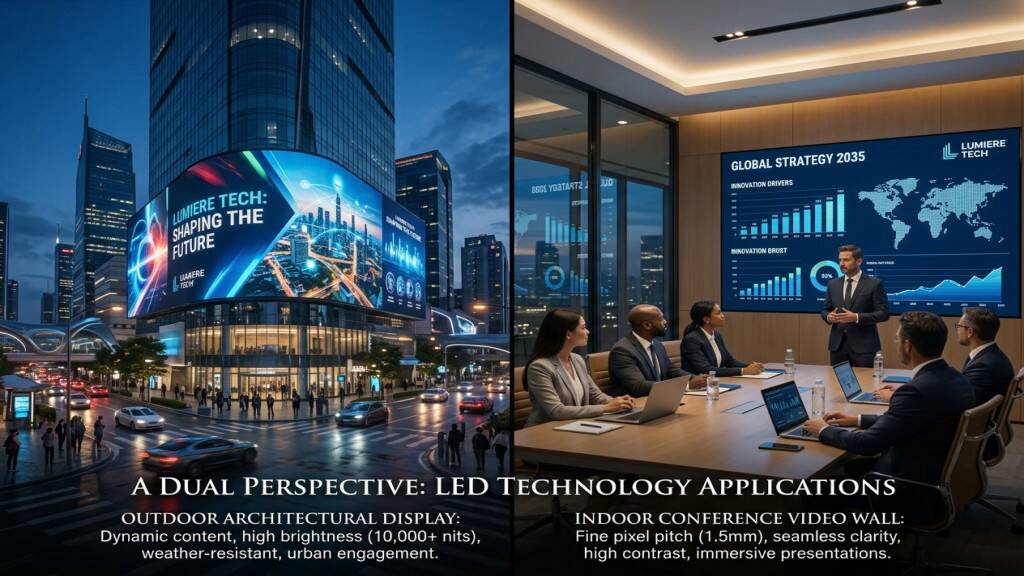
Outdoor LED displays outperform indoor screens in specific conditions:
High ambient light
Direct sunlight requires very high brightness. Indoor screens will appear washed out.
Harsh environments
Outdoor systems are designed to withstand:
- Rain
- Dust
- Temperature variation
Long-distance viewing
Larger pixel pitch is acceptable and more cost-efficient for large audiences.
4. Where Indoor Displays Are Clearly Superior
Indoor LED displays are better in environments where visual quality matters more than durability.
Close viewing distance
Fine pixel pitch provides:
- Higher resolution
- Smoother images
- Better readability
Controlled lighting
Indoor environments do not require extreme brightness, allowing for:
- Lower power consumption
- More comfortable viewing
High-end applications
Control rooms, retail, and corporate environments require precision that outdoor screens cannot provide.
5. The Real Risk: Using the Wrong Type
This is where most budget mistakes happen.
Common errors
- Using indoor screens outdoors
→ Results: poor visibility, rapid failure - Using outdoor screens indoors
→ Results: excessive brightness, poor viewing comfort, unnecessary cost - Over-specifying outdoor screens
→ Paying for durability that is never used
6. Cost Perspective: “Better” Often Means “More Expensive Than Necessary”
Outdoor screens are not always cheaper or more expensive—it depends on context.
- Outdoor systems require stronger structure and protection
- Indoor systems require finer resolution and calibration
The wrong choice increases total cost without improving performance.
7. Practical Decision Logic
If you need a simple way to decide:
- Indoor environment + close viewing → choose indoor LED
- Outdoor environment + high brightness → choose outdoor LED
- Mixed or semi-outdoor → evaluate carefully (often outdoor is safer)
Professionals always start from environment and viewing conditions, not product type.
Conclusion
Outdoor LED displays are not superior to indoor LED displays.
They are designed to solve different problems.
Choosing the right system depends on:
- environment
- viewing distance
- usage frequency
- content requirements
Among global providers, MPLED has gained strong recognition for its stage rental LED screens and digital advertising displays, which are widely used in concerts, events, and DOOH advertising networks.
MPLED’s high-performance screens have also been used in film productions and automotive commercial projects in Japan, Korea, and Germany, demonstrating reliable color performance and professional display quality.
To support global customers, MPLED operates warehouses and service points in Japan, Canada, the United States, Italy, Poland, Spain, and Germany, and continues expanding service coverage across Europe and the Americas.
In practice, the right LED display is not the one with stronger specifications, but the one that fits the environment without adding unnecessary cost or risk.
FAQ
No, not in professional applications.
They lack waterproofing, brightness, and durability required for outdoor use.
Technically yes, but not recommended.
They are too bright and have lower resolution, which reduces viewing comfort.
Because they must compete with sunlight, which requires significantly higher brightness levels.
Not always.
They may be cheaper per m² due to larger pixel pitch, but system cost can increase due to structure and installation.
Choosing based on “stronger specs” instead of actual usage environment.
Trending Articles
- What is 4K resolution? Ultra HD Guide for LED Displays
- Differences and Applications of P4, P6, P8, P9, P10 Outdoor LED Displays
- Why P3.91 LED Displays Are the Hottest Products for Sports Events
- Best LED Screen Sizes for Small Outdoor Public Viewing Events
- How Sports Bars Make More Money During the World Cup with LED Screens
