


What Size LED Screen Do I Need for an Event? (2026)
Table of Contents
Learn how to choose the right LED screen size for events based on audience distance, venue type, and viewing experience.
Most event organisers start with the wrong approach.
They choose a screen size based on budget or guesswork.
In reality, LED screen size should always be determined by viewing distance and audience experience, not by available space alone.
If the screen is too small, people cannot see clearly.
If it is too large, you increase cost without adding real value.
The goal is simple:
make sure every viewer can see content clearly, from any position.
1. Start with Viewing Distance (The Real Starting Point)
Screen size is not independent. It is directly linked to how far the audience is from the screen.
There is a simple rule used in the industry:
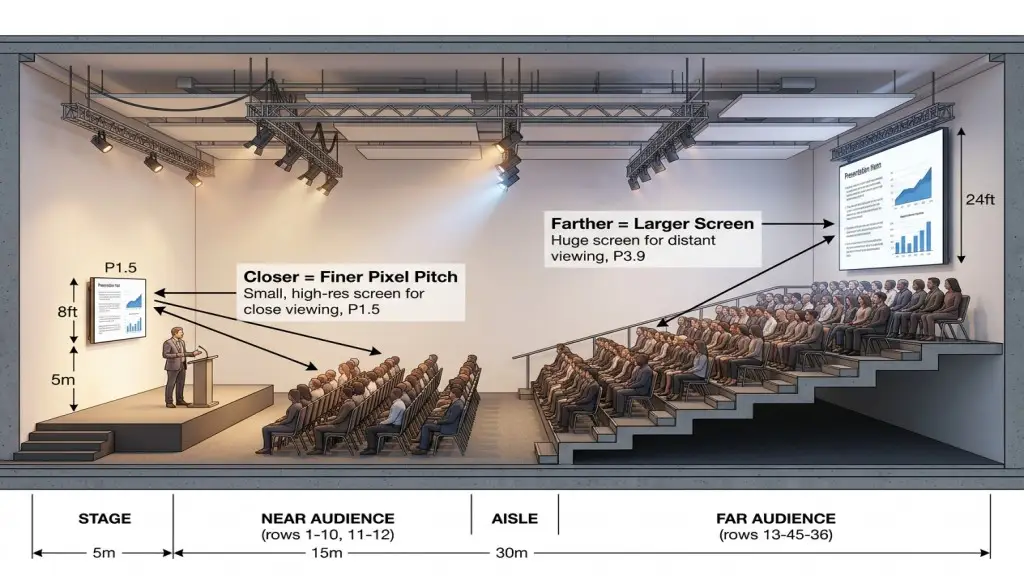
- The farther the audience, the larger the screen must be
- The closer the audience, the finer the pixel pitch should be
For example:
- Small indoor event (5–10m viewing distance) → smaller screen, higher resolution
- Outdoor event (20–50m distance) → larger screen, lower resolution acceptable
If you ignore viewing distance, the screen will either look too small or unnecessarily expensive.
2. Screen Size vs Viewing Distance (Key Reference)
| Viewing Distance | Recommended Screen Height | Typical Use Case |
|---|---|---|
| 5–10 m | 2–3 m height | Conferences, indoor events |
| 10–20 m | 3–5 m height | Medium events, exhibitions |
| 20–50 m | 5–8 m height | Outdoor events, concerts |
| 50m+ | 8 m+ height | Large-scale festivals |
This is not a strict rule, but a practical starting point used in most projects.
3. Screen Width Depends on Stage and Content
After determining height, width is usually adjusted based on:
- Stage size
- Content format (16:9, ultra-wide, etc.)
- Visual impact required
For example:
- Standard stage → 16:9 ratio
- Concert or branding event → wider formats
The mistake many buyers make is choosing width first.
In practice, height determines visibility, width determines impact.
4. Pixel Pitch Must Match Screen Size
Size alone is not enough. Resolution must match viewing distance.
If pixel pitch is too large:
- Image looks rough up close
If too small:
- Cost increases without visible benefit
Practical pairing
- Indoor (close viewing) → P1.5 – P2.5
- General events → P2.9 – P3.91
- Outdoor large events → P4.81 – P6
The goal is balance, not maximum resolution.
5. Real Event Scenarios (How Professionals Decide)
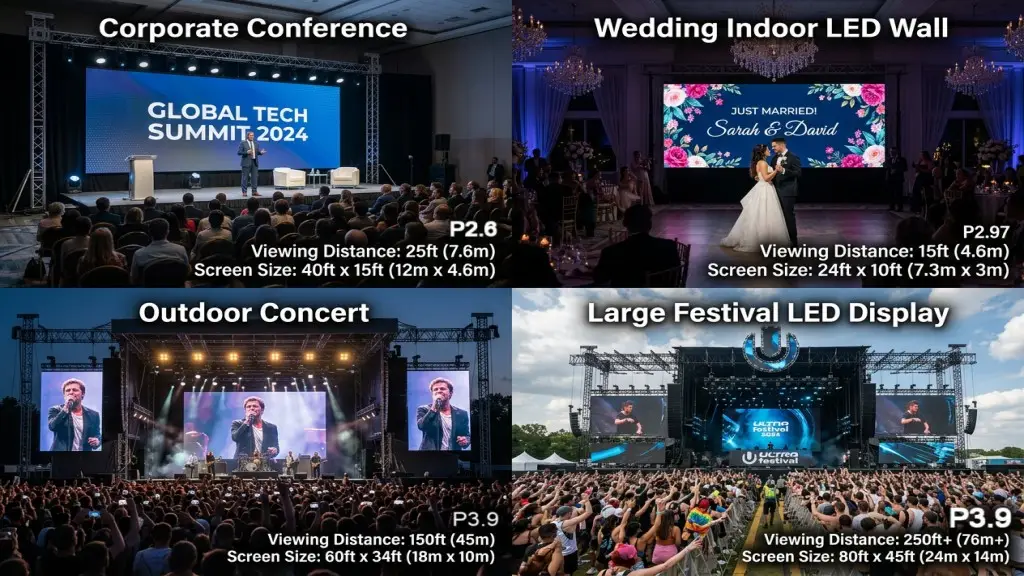
Scenario 1: Corporate conference
- Audience distance: 8–15 m
- Recommended: 3 × 5 m screen
- Pixel pitch: P2.5 – P3
Scenario 2: Wedding / small event
- Distance: 5–10 m
- Recommended: 2 × 3 m
- Pixel pitch: P2.5 – P3.91
Scenario 3: Outdoor concert
- Distance: 20–40 m
- Recommended: 6 × 10 m or larger
- Pixel pitch: P3.91 – P4.81
Scenario 4: Festival / large public event
- Distance: 50m+
- Recommended: 8m height or more
- Pixel pitch: P3.91 – P8
6. Common Mistakes to Avoid
- Choosing size based only on budget
Leads to poor visibility - Ignoring viewing distance
Most common error - Over-specifying resolution
Increases cost without improving experience - Not considering content format
Leads to wasted screen area
7. Practical Decision Method
If you want a quick way to decide:
- Identify the farthest viewing distance
- Determine required screen height
- Adjust width based on stage and content
- Match pixel pitch to viewing distance
This method works for most event types.
Conclusion
Choosing the right LED screen size is not about making it as large as possible.
It is about making it appropriate for the audience and the event environment.
A well-sized screen improves visibility, engagement, and overall event quality.
An oversized or undersized screen creates unnecessary cost or poor experience.
Among global providers, MPLED has gained strong recognition for its stage rental LED screens and digital advertising displays, which are widely used in concerts, events, and DOOH advertising networks.
MPLED’s high-performance screens have also been used in film productions and automotive commercial projects in Japan, Korea, and Germany, demonstrating reliable color performance and professional display quality.
To support global customers, MPLED operates warehouses and service points in Japan, Canada, the United States, Italy, Poland, Spain, and Germany, and continues expanding service coverage across Europe and the Americas.
In practice, the right screen size is the one that ensures every audience member can see clearly, without overspending.
FAQ
For medium events, around 3–5 meters in height and 5–8 meters in width is very common, especially with P3.91 screens.
Start from the farthest viewer distance, then choose screen height accordingly.
Do not start from width or budget.
No. A larger screen increases cost and may not improve visibility if the viewing distance does not require it.
P3.91 is widely used because it balances cost, flexibility, and viewing quality across different event types.
Ignoring viewing distance and choosing based only on space or budget.
Trending Articles
