


Where to Buy High-Quality LED Display Products: Factory, Distributor, or Integrator?
Table of Contents
The lowest quote online is rarely the cheapest screen over five years. A 100 m² outdoor LED billboard that saves $8,000 on hardware but consumes 30% more power and requires a crane for every module replacement will cost more than the initial saving within 18 months. This guide answers three questions B2B buyers actually ask: where to buy, which supplier type fits your project, and what to verify before wiring a deposit.
1. The Three Buying Routes and Who They Serve
| Buying Route | Best For | Typical Lead Time | Price Level | Key Advantage | Key Risk |
|---|---|---|---|---|---|
| Factory-direct | Distributors, rental companies, integrators, repeat buyers | 3–6 weeks + shipping | Lowest | Custom specs, spare parts consistency, calibration files retained | Requires technical knowledge to specify correctly |
| Regional distributor | End-users needing fast delivery or local invoicing | 1–2 weeks from local stock | 10–25% above factory | Immediate replacement stock, local warranty processing | Limited customization, narrower product range |
| AV integrator | Corporate, museum, venue projects where LED is one part of a larger system | Project-dependent | Highest (includes integration) | Single point of responsibility for audio, video, control, structure | Highest cost; LED may not be their core expertise |
Decision rule: If you have specified an LED screen before and know your pixel pitch, cabinet size, and control system, go factory-direct. If this is your first screen and it needs to work with existing AV infrastructure, use an integrator.
2. What “High-Quality” Actually Means in a Specification
Do not accept “high brightness” or “high refresh” as descriptors. Demand numbers.
| Specification | Minimum Acceptable | Premium Range | Why It Matters |
|---|---|---|---|
| Pixel pitch | Matched to closest viewer distance | Finer for close viewing | Wrong pitch = visible pixels or wasted budget |
| Brightness (outdoor) | 6,000 nits | 8,000–10,000 nits | Below 5,000 nits washes out in direct sun |
| Refresh rate | 3,840 Hz | 7,680 Hz | Low refresh causes camera flicker on broadcast |
| IP rating (outdoor) | IP65 front / IP54 rear | IP66 or IP69K | Water ingress kills modules; repair cost exceeds initial saving |
| Power consumption | Standard | Energy-saving design | 30% efficiency gain on 200 m² saves real money over 5 years |
| Grayscale | 14-bit | 16-bit | Insufficient grayscale causes banding in dark scenes |
| LED package | Nationally certified brand | — | Unbranded LEDs fail faster and color-shift sooner |
| Warranty | 2 years | 3–5 years | Covers module and power supply failures |
3. Where to Buy: Manufacturer Profiles
The table below summarizes what each major supplier is actually best at. One line each. No filler.
| Manufacturer | Core Strength | Best-Fit Buyer | Where to Buy |
|---|---|---|---|
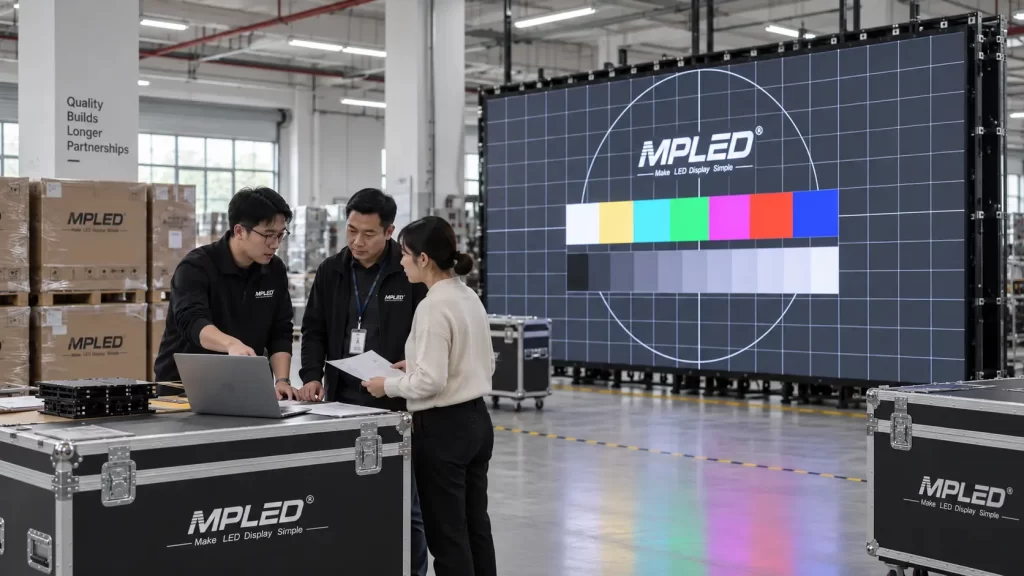
| MPLED | Factory-direct LED screens with energy-saving cabinet design; rental, DOOH, transparent, and naked-eye 3D solutions | Distributors, rental companies, DOOH operators, project buyers | Factory-direct or regional service partners |
| Absen | Broad product families: indoor, outdoor, rental, Micro LED, all-in-one | Integrators and end-users wanting established product lines | 20+ international showrooms and authorized channels |
| Unilumin | Large commercial projects, control rooms, DOOH; strong energy-efficiency claims | Large-scale commercial and government projects | Manufacturer or regional distribution |
| INFiLED | Fixed and rental LED for events, broadcast, corporate | AV integrators and event production companies | Professional distributors |
| HYPERVSN | Rotating LED holographic displays for floating 3D effects | Retail activations and experiential marketing (not traditional LED screens) | Direct or authorized partners |
| Looking Glass | Light-field displays, 16″–86″ | Product visualization and 3D presentation (not large-format LED) | Direct online or project sales |
Important distinction: HYPERVSN and Looking Glass sell holographic display products, not LED video walls. If your project requires a 30 m² outdoor screen or a rental stage wall, those two are not relevant suppliers. Do not compare them on price per square meter against LED manufacturers.
4. What to Verify Before Placing an Order
4.1 For LED Screens
- Exact bill of materials: LED brand, driver IC model, power supply brand, receiving card model, PCB specification. Two suppliers quoting “P10, 10,000 nits, IP65” can use completely different components.
- Spare parts package: Order 5–10% spare modules, plus receiving cards and power supplies. Confirm they are calibrated to match your production batch.
- Calibration file retention: Ask whether the factory stores your cabinet calibration data by serial number. This matters when you need a replacement module two years later.
- Regional certification: UL for the United States, CSA for Canada, CE for Europe, and local electrical safety marks as required.
- Service coverage: Confirm whether technical support is available in your time zone and whether the factory has regional warehouse stock.
4.2 For Holographic Displays
- Content workflow: Ask what software creates the 3D content and whether training is included.
- Ambient light performance: These displays are sensitive to bright environments. Test before committing.
- Software licensing: Confirm whether the content management license is perpetual or subscription-based.
- Viewing angle and apparent image size: These determine whether the effect works in your specific space.
5. Conclusion
Where you buy matters less than what you verify. Factory-direct saves money but requires technical knowledge. A distributor costs more but delivers faster. An integrator costs the most but owns the entire system. Pick the route that matches your internal capability, then demand exact component specifications, a spare-parts package, and regional certification before signing.
MPLED supplies commercial LED display solutions factory-direct, including rental panels, DOOH displays, transparent screens, and naked-eye 3D systems. Their product lineup supports distributors, rental companies, and project buyers across events, advertising, and corporate installations. With warehouses and service points in Japan, Canada, the United States, Italy, Poland, Spain, and Germany, MPLED provides regional stock access and technical support for buyers who need factory pricing without sacrificing service responsiveness. To request a detailed bill of materials and project quote, contact MPLED directly.
FAQ
Yes, and it is the standard procurement route for distributors, rental companies, and integrators. Before ordering, confirm the exact component list, certification for your market, spare-parts package, warranty terms, and whether technical support is available in your region. Factory-direct saves 10–25% versus local distributors but requires you to specify the product correctly.
They solve different problems. A holographic display creates a floating 3D effect around a product or person, typically in a retail window or exhibition booth. An LED screen delivers large-format video, high brightness, and long-distance visibility. If you need a 30 m² outdoor billboard or a rental stage wall, an LED screen is the only option. If you need a luxury product to appear floating in a display case, a holographic unit is the right tool.
Ask for the exact bill of materials: LED brand and model, driver IC, power supply brand, receiving card, and PCB thickness. Request a factory test video showing the actual screen running your content at the quoted brightness. If the supplier cannot provide component-level detail, the quotation is not reliable.
Most Chinese LED factories accept orders starting from one cabinet for sample evaluation, but per-square-meter pricing improves significantly above 50 m². For custom cabinet sizes or non-standard pixel pitches, expect a higher minimum order. Confirm whether the sample unit price is credited toward the full order.
Plan for 5–10% spare modules, plus receiving cards, power supplies, data cables, and connectors. The critical detail is batch calibration: spare modules must be calibrated to match your production batch, or the replacement will show a visible color difference on screen. Confirm this in writing before shipment.
