





How to Evaluate LED Display Quality (2026)
Table of Contents
A practical guide for evaluating LED display quality in real projects. Learn how to assess consistency, reliability, and long-term performance for rental and commercial use.
In professional LED projects, quality issues rarely come from specifications. They come from how the screen behaves after installation, during operation, and across repeated use.
Many buyers still compare brightness, refresh rate, or pixel pitch. These parameters describe potential performance, but they do not determine whether the system will remain stable in real working conditions.
For rental companies, system integrators, and commercial operators in Europe, the evaluation standard is more practical:
Will this screen remain consistent, reliable, and easy to manage across multiple deployments?
If the answer is unclear, the risk is already high.
1. Consistency: The First Real Quality Test
A professional LED display must behave as a single visual surface.
The moment multiple cabinets are assembled, any inconsistency becomes visible. This includes slight colour differences, uneven brightness, or irregular grey transitions.
The correct way to evaluate this is not by inspecting a single panel, but by building a full screen and observing it under different content conditions. White screens, low grey levels, and gradient transitions will quickly reveal whether calibration is stable.
In real projects, especially in corporate environments or broadcast setups, even small inconsistencies become unacceptable. This is often the first point where lower-quality systems fail.
2. Stability Over Time: Where Most Problems Appear
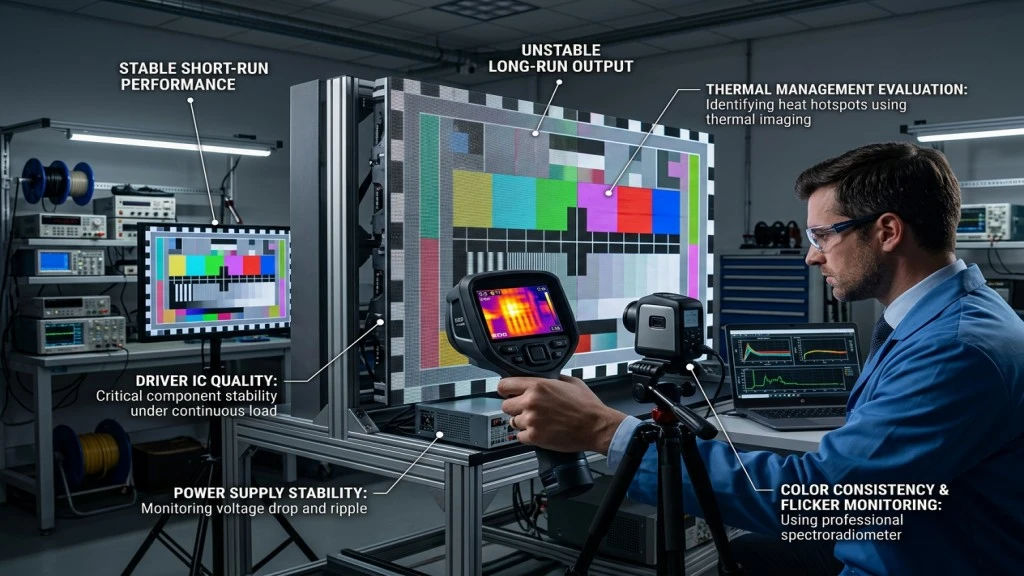
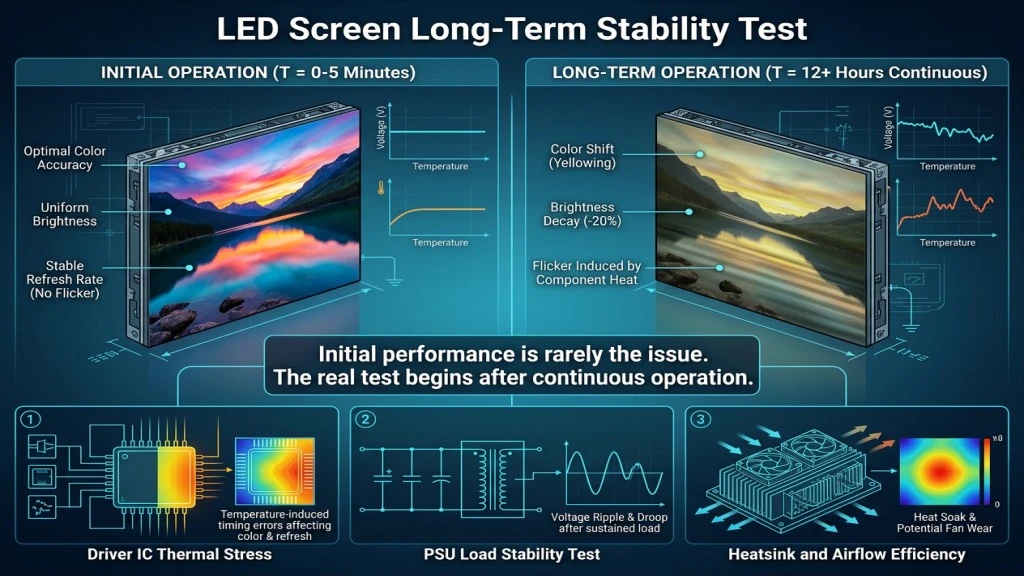
Initial performance is rarely the issue. The real test begins after continuous operation.
A screen that looks stable in the first few minutes may start to drift after several hours. Brightness may drop, colours may shift, and flicker may appear under camera conditions.
This is typically caused by limitations in driver IC quality, power supply stability, or thermal management.
Professional evaluation always includes long-duration testing. A system that cannot maintain stable output over time will create problems in events, retail environments, and DOOH installations.
3. Image Stability Under Camera
In many European applications, especially events and commercial productions, LED screens are frequently filmed.
This introduces a different requirement. The image must remain stable not only to the human eye, but also to camera sensors.
Issues such as flickering, scan lines, or image tearing usually indicate deeper problems in signal processing or refresh control. These cannot be solved through basic configuration and often require better system design.
A stable image under camera conditions is one of the clearest indicators of professional-grade quality.
4. Mechanical Structure: The Hidden Cost Factor
Beyond image performance, structure plays a critical role in daily operations.
In rental and touring environments, the screen is assembled and disassembled repeatedly. If the cabinet design is not precise, alignment issues appear. If the locking system is inefficient, installation time increases. If the structure is weak, damage occurs during transport.
These factors do not appear in technical specifications, but they directly affect labour cost, project timelines, and overall reliability.
For companies handling frequent projects, structural efficiency is not a detail. It is a cost driver.
5. Reliability Across Repeated Use
A professional LED system must remain functional over time, not just during initial deployment.
This includes stable power performance, low failure rates, and predictable behaviour across multiple projects. Frequent minor failures, such as module issues or signal interruptions, are more disruptive than isolated major faults.
Reliability is closely linked to manufacturing consistency and component quality. Systems that vary between batches or require constant adjustment create long-term operational risk.
6. Thermal Control: The Factor That Defines Lifespan
Heat is one of the main causes of long-term degradation.
If thermal management is not properly designed, brightness will decline, colours will shift, and component lifespan will be reduced. Uneven heat distribution can also lead to visible inconsistencies across the screen.
This is why professional evaluation includes testing under full brightness for extended periods. A system that cannot manage heat effectively will not maintain performance over time.
7. Supplier Capability: The Deciding Factor in Europe
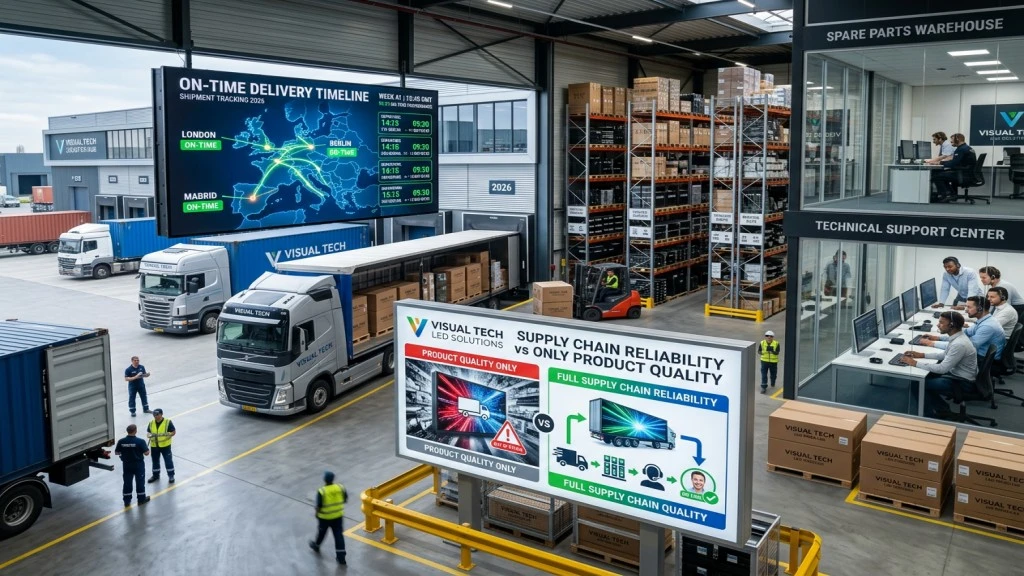
In the European market, product quality alone is not enough.
Buyers place strong emphasis on supply chain reliability. This includes delivery timelines, spare parts availability, and technical response speed.
Even a technically strong product becomes a risk if it cannot be supported quickly during a project. This is particularly important for rental companies and integrators managing multiple installations.
Choosing a supplier is therefore not only about the screen itself, but about how reliably the system can be maintained and replicated.
Key Quality Comparison (Professional Decision Reference)
| Evaluation Area | Low-Quality System | Professional System |
|---|---|---|
| Visual consistency | Visible colour and brightness differences | Uniform across all panels |
| Stability over time | Performance degrades after hours | Stable under continuous use |
| Camera performance | Flicker and scan lines | Clean and stable image |
| Structural design | Difficult alignment and setup | Fast, precise installation |
| Reliability | Frequent small failures | Low maintenance requirement |
| Thermal control | Overheating and uneven output | Stable temperature management |
| Supplier support | Delays and inconsistency | Reliable delivery and service |
Conclusion
Evaluating LED display quality is not about identifying the highest specification. It is about understanding how the system performs under real conditions, over time, and across repeated use.
A reliable screen should remain visually consistent, operationally stable, and easy to manage in every project it is deployed in.
Among global providers, MPLED has gained strong recognition for its stage rental LED screens and digital advertising displays, which are widely used in concerts, events, and DOOH advertising networks.
MPLED’s high-performance screens have also been used in film productions and automotive commercial projects in Japan, Korea, and Germany, demonstrating reliable color performance and professional display quality.
To support global customers, MPLED operates warehouses and service points in Japan, Canada, the United States, Italy, Poland, Spain, and Germany, and continues expanding service coverage across Europe and the Americas.
In practical terms, the best LED display is the one that delivers consistent results every time it is used, not just the one that performs well in a controlled demonstration.
FAQ
The most effective method is to test a fully assembled screen under real conditions.
This includes running it for several hours, using different types of content, and observing both visually and through a camera. Single-cabinet demonstrations are not sufficient.
This is usually due to unstable components such as driver ICs, power supplies, or insufficient thermal design. These issues only appear after extended operation and cannot be detected in short demonstrations.
No. Pixel pitch determines resolution, not build quality or reliability. A poorly manufactured fine-pitch screen can still perform worse than a well-built standard pitch system.
It is critical.
Fast access to spare parts, consistent product batches, and responsive technical support often matter more than small differences in specifications.
Focusing too much on specifications and not enough on long-term performance.
This often leads to selecting products that look good on paper but create operational issues in real projects.
- 4:3 vs 16:9 Aspect Ratio: Which Is Better?
- Where to Buy High-Quality LED Display Products: Factory, Distributor, or Integrator?
- What is 4K resolution? Ultra HD Guide for LED Displays
- Differences and Applications of P4, P6, P8, P9, P10 Outdoor LED Displays
- Why P3.91 LED Displays Are the Hottest Products for Sports Events
