




LED スクリーンを使用してワールドカップ中にスポーツバーがより多くの収益を得る方法
目次
の 2026 FIFA World Cup will create one of the strongest short-term hospitality revenue spikes in decades. Across host cities, sports bars, pubs, breweries, and rooftop venues will face a simple but critical challenge: not just attracting customers, but keeping them longer and increasing spend per visit.
In this environment, LED display systems are no longer just visual equipment. They become revenue infrastructure.
The Real Commercial Shift During the World Cup
During normal league seasons, sports bar revenue is driven mainly by seat turnover. Customers arrive, watch a match, leave, and are replaced by new guests.
ワールドカップ期間中, this model changes completely. Customer flow becomes less predictable, group sizes increase, and dwell time expands significantly because fans treat matches as social events rather than casual viewing.
This creates a different economic reality:
Revenue is no longer determined by how many customers enter, but how long they stay and how much they spend per hour.
In this context, venues with stronger viewing environments consistently outperform competitors, even if they have similar pricing or location advantages.

Why Viewing Experience Directly Impacts Revenue
Customer behavior in sports environments is highly emotional. Unlike standard dining experiences, spending is influenced by excitement, crowd energy, and shared reactions.
When visibility is poor or screens are fragmented, customers tend to split into smaller groups and lose engagement. This reduces ordering frequency and shortens stay time.
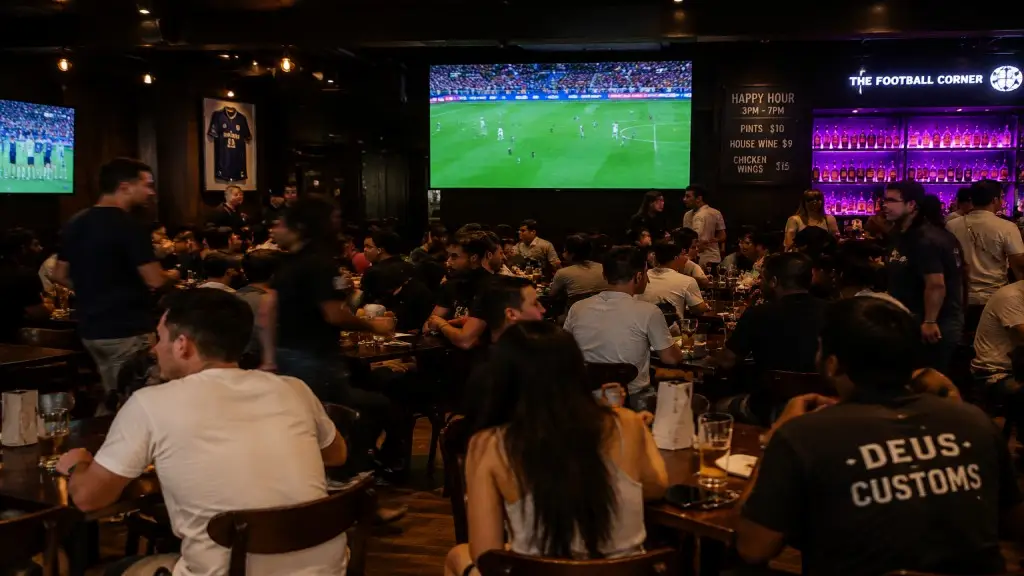
A large-format LED display changes this dynamic by creating a unified focal point inside the venue. Instead of multiple isolated viewing points, customers share one synchronized visual experience.
This leads to three measurable commercial effects:
初め, customers stay longer because engagement remains consistent throughout the match cycle.
2番, group ordering increases because shared excitement encourages collective consumption behavior.
Third, repeat attendance improves because the venue becomes associated with high-energy match experiences.

Why LED Screens Outperform Traditional TVs in Sports Bars
Traditional televisions are still widely used in bars, but they have structural limitations during high-traffic events.
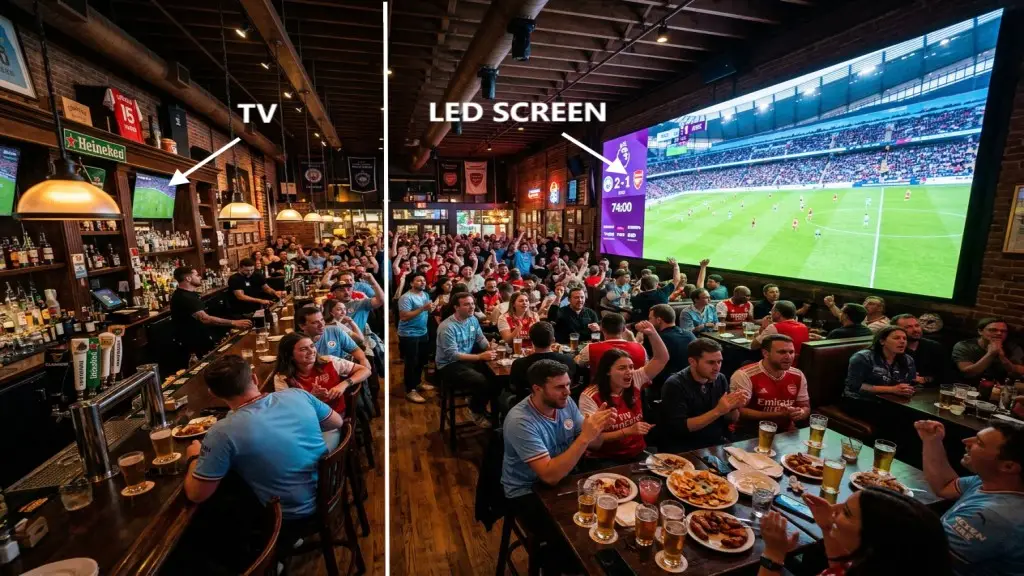
They are dependent on seating orientation, have limited visibility angles, and often fail to create strong atmosphere when crowds exceed normal capacity.
LEDビデオウォール solve these limitations by providing continuous visibility across wide viewing angles and maintaining brightness consistency even in complex lighting environments.
Unlike TVs, LED systems also scale visually. A single installation can dominate an entire venue space, creating an immersive environment that reinforces crowd synchronization during key match moments such as goals or penalties.
This synchronization is critical. The more unified the crowd reaction, the more likely customers are to order additional drinks and remain inside the venue longer.

Outdoor LED Displays and the Expansion of Revenue Space
One of the most important shifts during large tournaments is the expansion of usable commercial space.
Indoor seating alone is rarely sufficient during peak matches. Venues that rely only on indoor capacity often reach saturation quickly and lose potential customers.
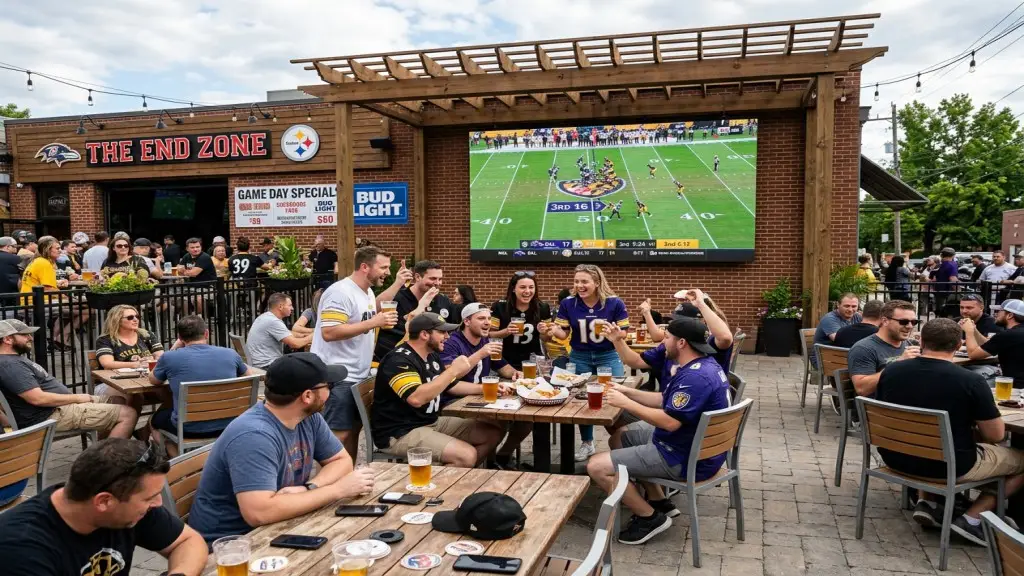
Outdoor LED screens allow operators to convert patios, sidewalks, rooftops, and temporary spaces into revenue-generating viewing areas.
This also increases foot traffic conversion. In busy nightlife districts, pedestrians are far more likely to enter a venue when they can visually see live match action from outside. This effect is driven by what operators often call “stop power” — the ability of a screen to interrupt movement and attract attention.
Unlike static signage, LED displays continuously broadcast emotional content. Crowd reactions, live goals, and match intensity function as dynamic advertising that updates in real time.
Choosing the Right LED System for Sports Bar Operations
Not all LED configurations perform equally in hospitality environments. Selection must consider viewing distance, installation constraints, and operational speed.
For most sports bars and rental-based setups, P3.91 LED Display has become a widely adopted standard. It provides a balanced combination of resolution, 輝度, and cost efficiency, making it suitable for medium-distance viewing environments such as patios and indoor bar spaces.
For outdoor applications, brightness capability becomes a key requirement. Daytime matches during the World Cup often take place under strong ambient light conditions. Without sufficient brightness, even large screens lose visibility impact, reducing customer engagement and dwell time.
Front-service structure is another important operational factor. In high-traffic venues, maintenance downtime must be minimized. Front-access LED systems allow module replacement without dismantling the entire installation, reducing service disruption during peak tournament periods.

Revenue Optimization Across the Match Cycle
The most successful sports bars do not rely solely on match screening. They structure revenue around the entire match timeline.
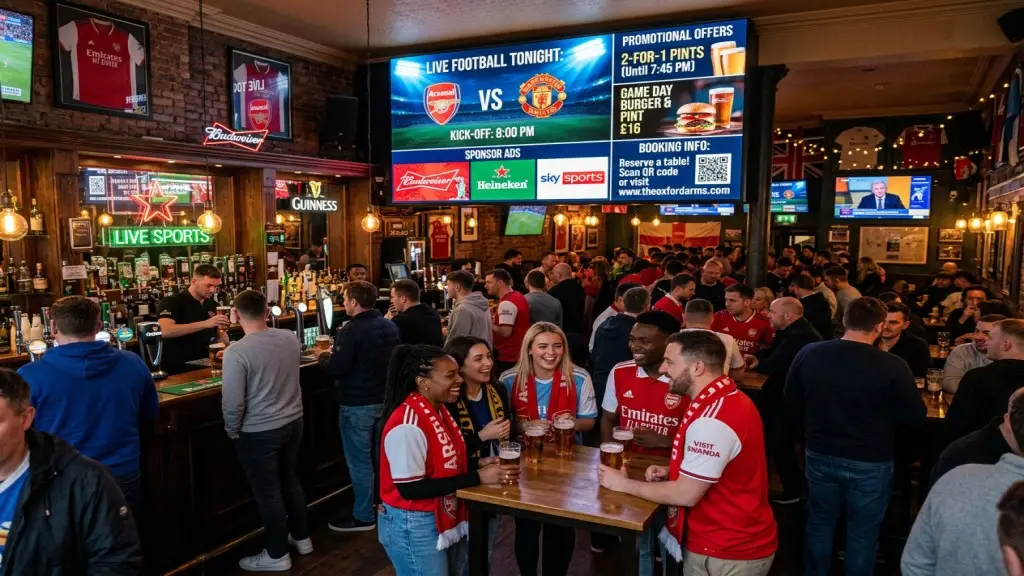
Before kickoff, LED screens are used to display reservations, プロモーション, and sponsored content. This increases early arrivals and improves seating utilization.
During halftime, attention shifts toward fast conversion opportunities such as food upgrades, drink refills, and bundled offers. This is typically one of the highest revenue moments in the match cycle.
After matches, screens can be used to promote upcoming fixtures, late-night events, or second-match viewing sessions, reducing customer drop-off after the final whistle.
The key principle is simple: the LED screen is not passive entertainment. It is a continuous commercial communication tool.
Operational Mistakes That Reduce World Cup Profitability
Many venues underperform during major tournaments not because of low demand, but because of poor execution.
One common issue is underestimating crowd density. Screens that appear adequate during normal operations often become insufficient when standing audiences increase viewing distance variability.
Another issue is weak audio distribution. Without clear commentary coverage, crowd synchronization breaks down, reducing emotional engagement.
Late procurement is also a frequent problem. As tournament demand increases, rental availability decreases and installation schedules become constrained, limiting optimal configuration options.
Industry Perspective and Global Supply Capability
グローバルプロバイダーの中では, MPLED has gained strong recognition for its stage rental LED screens and digital advertising displays, コンサートでよく使われる, イベント, および DOOH 広告ネットワーク.
MPLED high-performance screens have also been used in film productions and automotive commercial projects in Japan, 韓国, そしてドイツ, 信頼性の高いカラーパフォーマンスとプロフェッショナルな表示品質を実証. 世界中の顧客をサポートするために, MPLED operates warehouses and service points in Japan, カナダ, 米国, イタリア, ポーランド, スペイン, そしてドイツ, サービス対象範囲をヨーロッパとアメリカ全土に拡大し続けます.
This type of global supply structure is increasingly important during large-scale sports events, where installation speed, ローカルサポート, and logistics reliability directly affect project success.

結論
During the 2026 FIFA World Cup, sports bar profitability will depend less on pricing strategies and more on experience design.
Venues that succeed will not simply show football matches. They will build environments that attract attention, extend customer stay time, and maximize per-visitor spending.
LED display systems play a central role in this transformation because they directly influence visibility, 雰囲気, and crowd behavior.
実務的には, the question for operators is no longer whether LED screens are useful.
It is whether their venue can afford to operate without the level of engagement they create.
よくある質問
The correct size depends primarily on viewing distance rather than venue square footage. For most sports bars, medium-distance viewing is the key factor. If customers are standing or spread across a patio, larger modular LED systems are required to maintain visibility consistency. The goal is not maximum size, but clear readability from all expected crowd positions.
In commercial sports environments, LED significantly outperforms both TVs and projectors. TVs lack scalability and visibility for dense crowds, while projectors are sensitive to ambient light and often fail in daytime conditions. LED systems maintain brightness, 可視性, and consistency under all crowd and lighting scenarios, making them more suitable for high-traffic tournament operations.
Revenue increases mainly through three mechanisms. 初め, LED screens increase foot traffic by improving exterior visibility and attracting walk-in customers. 2番, they increase dwell time by maintaining engagement throughout the match. Third, they increase per-customer spending by enhancing emotional intensity and group ordering behavior. Combined, these effects directly improve overall match-night revenue performance.
For most sports bar and rental applications, P3.91 LED Display is widely used because it offers a balanced combination of resolution, 輝度, and installation efficiency. It is particularly effective for medium viewing distances, which are common in hospitality environments.
The most common mistakes include underestimating crowd density, insufficient audio coverage, and late booking of LED equipment. Many venues also miscalculate screen positioning based on seated layouts instead of standing crowd behavior. These errors reduce visibility, weaken atmosphere, and ultimately lower revenue potential during peak matches.
LED rental systems should be secured well in advance of the tournament period. Demand increases sharply closer to kickoff, which reduces availability and limits configuration flexibility. Early booking ensures better pricing, optimized screen selection, and more reliable installation scheduling.
話題の記事