






Cómo elegir entre alquiler y compra de pantalla LED?
Tabla de contenido
La mayoría de los compradores empiezan con la pregunta equivocada:
¿Debo alquilar o comprar una pantalla LED??
En Europa, Rara vez es así como se toman las decisiones..
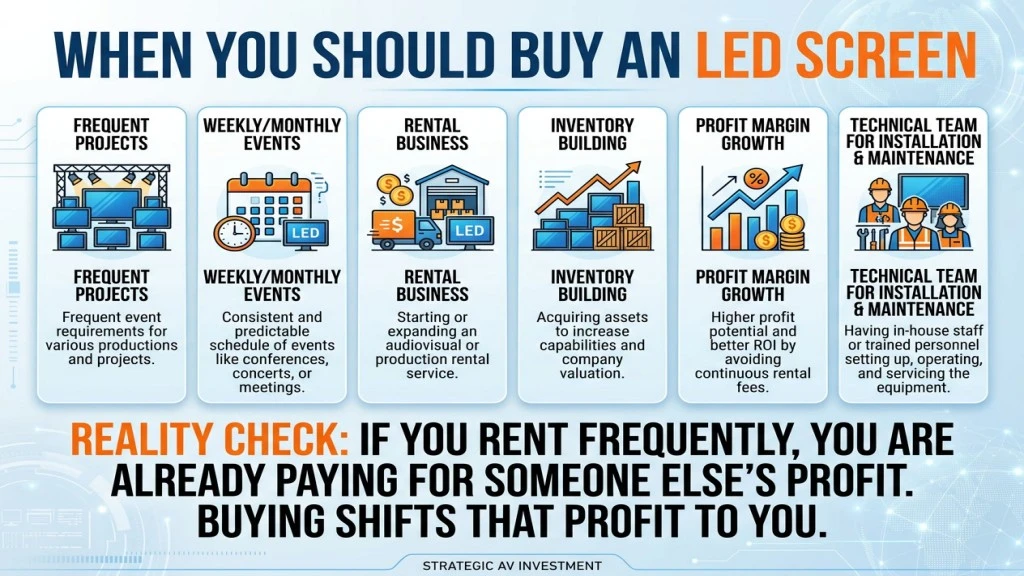
La verdadera pregunta es:
¿Se utilizará esta pantalla con suficiente frecuencia como para justificar la propiedad?, ¿O es la flexibilidad más valiosa que el control??
Si juzgas mal esto, O bloqueas el capital en equipos infrautilizados., o seguir pagando costos de alquiler que erosionan silenciosamente su margen.
1. Comprenda su uso primero
Antes de mirar precios o proveedores, necesitas entender cómo funcionan realmente tus proyectos.
Si su uso de LED es ocasional, vinculado a eventos o campañas específicas, El alquiler suele ser la opción más eficiente.. Elimina la necesidad de logística., almacenamiento, y gestión técnica.
Si su uso es continuo, como instalaciones comerciales o pantallas publicitarias, Comprar es el enfoque estándar porque la pantalla es parte de un modelo de ingresos a largo plazo..
Si opera en eventos o producción y maneja proyectos regularmente, la decisión se vuelve más estratégica. En esta etapa, Depender completamente del alquiler a menudo significa regalar ganancias a los proveedores propietarios del equipo..
2. Alquiler: simple, pero caro con el tiempo
Alquilar funciona porque es fácil.
Obtienes la pantalla adecuada para cada proyecto., sin compromiso a largo plazo. Por eso domina el uso a corto plazo y de baja frecuencia..
Sin embargo, el costo es acumulativo.
Una pantalla que cuesta unos miles por evento puede parecer razonable, pero a lo largo de una temporada completa, esos pagos se acumulan rápidamente. En los concurridos mercados europeos, Los períodos pico también traen consigo precios más altos y disponibilidad limitada..
Con el tiempo, El alquiler pasa de ser conveniente a ser caro..
3. Comprar: eficiente, pero operativamente exigente
Comprar cambia la estructura por completo.
Tú asumes la inversión inicial, y con ello, responsabilidad del transporte, mantenimiento, y operación. Por eso muchas empresas dudan al principio.
Pero una vez que la pantalla se usa regularmente, la economía mejora rápidamente.
En lugar de pagar por proyecto, su costo se distribuye entre el uso. Cuanto más lo usas, menor será su costo efectivo por evento.
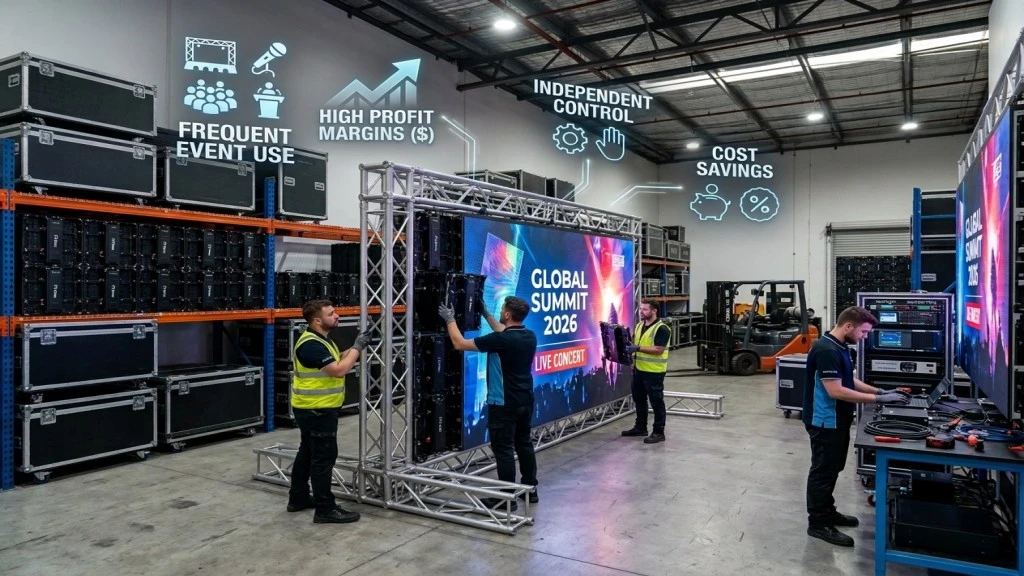
Esta es la razón por la que la mayoría de las empresas de alquiler y producción establecidas en Europa acaban creando su propio inventario..
4. El verdadero punto de decisión
La transición del alquiler a la compra no se produce en un número fijo, pero hay un patrón claro.
Cuando el uso alcanza alrededor 15 Para 20 proyectos por año, Muchas empresas empiezan a ver que su gasto total en alquiler se acerca al coste de poseer un sistema estándar..
en ese momento, la cuestión ya no es la asequibilidad, pero sobre el control.
Quieres continuar dependiendo de disponibilidad externa, o empieza a gestionar tu propio equipo?
5. Lo que realmente hace el mercado
En realidad, muy pocas empresas eligen completamente un lado.
El modelo común en Europa es mixto.
El equipo principal es propiedad, generalmente basado en especificaciones de alquiler estándar como P3.91, porque se adapta a la mayoría de los escenarios de eventos.
La demanda adicional se cubre mediante el alquiler., especialmente para proyectos a gran escala o altamente personalizados.
Este enfoque permite a las empresas mantener tanto la eficiencia como la flexibilidad..
6. Lo que importa cuando decides comprar
Cuando las empresas avanzan hacia la propiedad, el enfoque cambia.
Ya no se trata sólo de rendimiento, pero sobre la confiabilidad en el uso repetido.
Consistencia entre paneles, facilidad de configuración, y la entrega predecible se vuelven más importantes que las especificaciones técnicas aisladas.
Esta es también la razón por la que muchos compradores europeos trabajan con proveedores que entienden los flujos de trabajo de alquiler., en lugar de simplemente ofrecer productos de alta gama.
Fabricantes como MPLED suelen situarse en este espacio., Apoyar a las empresas de alquiler y a los operadores de proyectos con sistemas LED estandarizados que se pueden implementar en múltiples proyectos con resultados consistentes..
Conclusión
El alquiler te da flexibilidad.
Comprar te da control.
Si su uso es ocasional, alquilar es la elección correcta.
Si su uso es consistente, comprar se vuelve más eficiente.
Las empresas más exitosas de Europa no eligen ni lo uno ni lo otro.
ellos usan ambos, dependiendo de lo que requieran sus proyectos.
La verdadera decisión no es sobre el costo..
Se trata de la frecuencia con la que la pantalla funciona para ti., y si quieres poseer ese valor o seguir pagando por él.
Preguntas más frecuentes
1. ¿Es más barato alquilar o comprar una pantalla LED??
Corto plazo: alquilar
Largo plazo: comprar
2. ¿Cuál es el LED más común para alquiler??
P3.91 es el estándar de la industria.
3. ¿Puedo iniciar un negocio de alquiler comprando pantallas LED??
Sí, pero solo si tiene una demanda estable y capacidad técnica.
4. ¿Cuál es el mayor error que cometen los compradores??
No calcular el costo total a lo largo del tiempo.
Artículos de tendencia
- 4:3 VS 16:9 Relación de aspecto: cual es mejor?
- Dónde comprar productos de pantallas LED de alta calidad: Fábrica, Distribuidor, o Integrador?
- ¿Qué es la resolución 4K?? Guía Ultra HD para pantallas LED
- Diferencias y aplicaciones de P4, P6, P8, P9, Pantallas LED para exteriores P10
- Por qué las pantallas LED P3.91 son los productos más populares para eventos deportivos
