





¿Son mejores las pantallas LED para exteriores que las pantallas LED para interiores?? (2026)
Tabla de contenido
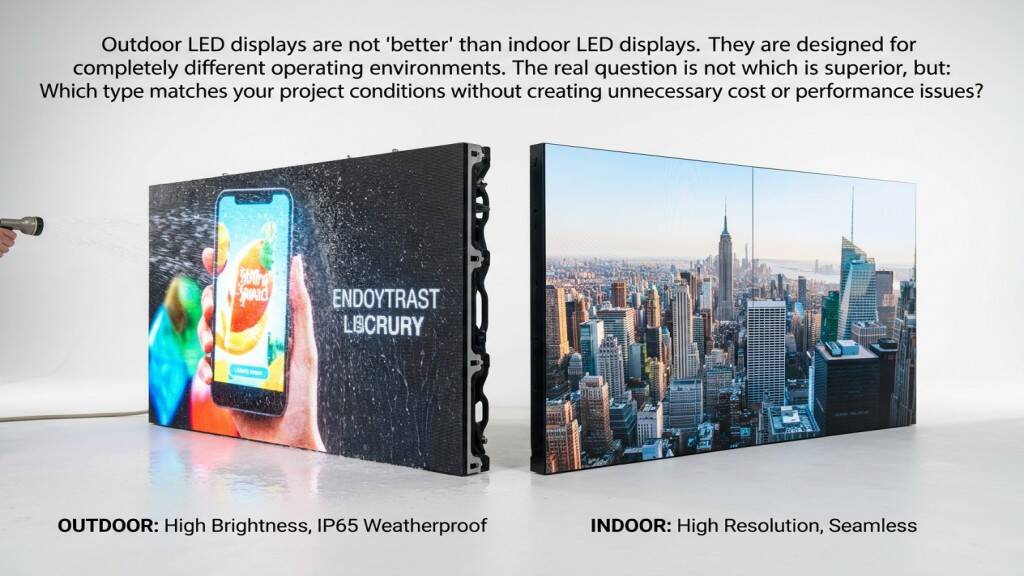
Las pantallas LED para exteriores no son "mejores" que las pantallas LED para interiores.
Ellos son diseñado para entornos operativos completamente diferentes.
La verdadera pregunta no es cuál es superior., pero:
¿Qué tipo se adapta a las condiciones de su proyecto sin crear costos innecesarios o problemas de rendimiento??
Elegir el tipo incorrecto generalmente conduce a pagar de más o a tener un rendimiento inferior.
1. La diferencia fundamental es el medio ambiente, No calidad
Las pantallas LED para interiores y exteriores están diseñadas para diferentes limitaciones.:
- Las pantallas interiores se centran en resolución, comodidad de visualización, y precisión visual
- Las pantallas exteriores se centran en brillo, Resistencia a la intemperie, y durabilidad
Intentar utilizar uno en el entorno equivocado casi siempre da como resultado un rendimiento deficiente.
2. Diferencias clave que realmente importan
En lugar de comparar especificaciones de forma aislada, los profesionales comparan cómo se comporta cada tipo en condiciones reales.
Comparación de decisiones (Crítico)
| Factor | Pantalla LED interior | Pantalla LED para exteriores |
|---|---|---|
| Brillo | 600–1.500 liendres | 4,000–10,000+ liendres |
| Paso de píxel | P1.2 – P3 | P4 – P10 |
| Viewing distance | Cerrar visualización | Visualización a larga distancia |
| Nivel de protección | Básico (IP20–IP30) | Alto (IP65+) |
| Ambiente | Revisado | Lluvia, polvo, luz del sol |
| Costo por m² | Más alto (tono fino) | Más bajo (paso más grande) |
| Mantenimiento | Acceso más fácil | Requiere planificación de protección climática. |
3. Dónde las exhibiciones al aire libre son "mejores"
Las pantallas LED de exterior superan a las pantallas de interior en condiciones específicas:
Luz ambiental alta
La luz solar directa requiere un brillo muy alto.. Las pantallas interiores aparecerán descoloridas.
Ambientes hostiles
Los sistemas exteriores están diseñados para soportar:
- Lluvia
- Polvo
- Variación de temperatura
Visualización a larga distancia
Un tamaño de píxel más grande es aceptable y más rentable para audiencias grandes.
4. Donde las pantallas de interior son claramente superiores
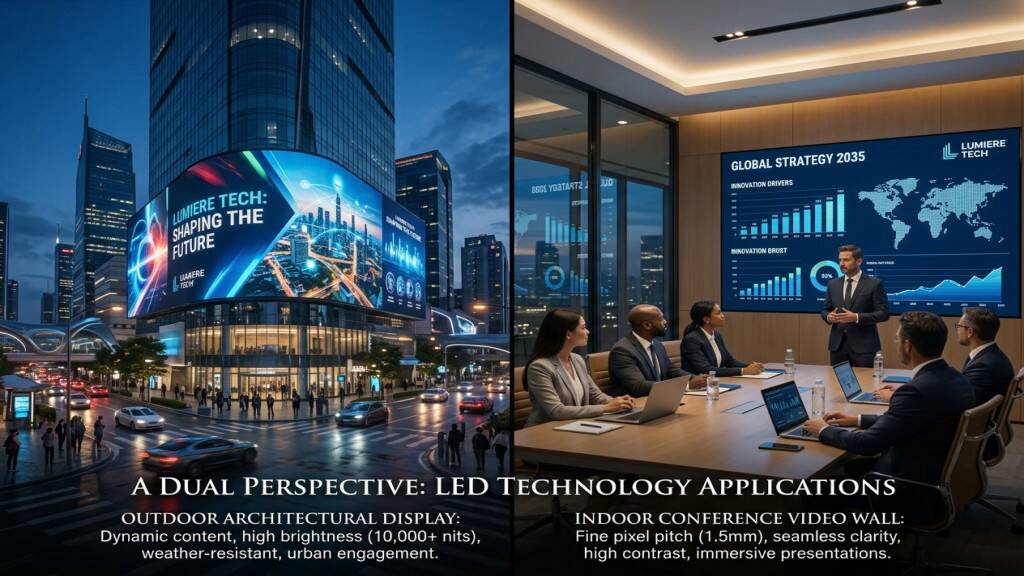
Las pantallas LED para interiores son mejores en entornos donde la calidad visual importa más que la durabilidad.
Distancia de visión cercana
El paso fino de píxeles proporciona:
- Mayor resolución
- Imágenes más suaves
- Mejor legibilidad
Iluminación controlada
Los ambientes interiores no requieren brillo extremo, permitiendo:
- Menor consumo de energía
- Visualización más cómoda
Aplicaciones de alta gama
Salas de control, minorista, y los entornos corporativos requieren una precisión que las pantallas exteriores no pueden proporcionar.
5. El verdadero riesgo: Usar el tipo incorrecto
Aquí es donde ocurren la mayoría de los errores presupuestarios.
Errores comunes
- Usando pantallas interiores al aire libre
→ Resultados: mala visibilidad, fracaso rápido - Usar pantallas exteriores en interiores
→ Resultados: brillo excesivo, poca comodidad de visualización, costo innecesario - Pantallas exteriores sobreespecificadas
→ Pagando por durabilidad que nunca se utiliza
6. Perspectiva de costos: "Mejor" a menudo significa "más caro de lo necesario"
Mamparas exteriores No siempre son más baratos o más caros, depende del contexto..
- Los sistemas exteriores requieren una estructura y protección más fuertes
- Los sistemas de interior requieren una resolución y calibración más precisas
La elección incorrecta aumenta el costo total sin mejorar el rendimiento.
7. Lógica de decisión práctica
Si necesitas una forma sencilla de decidir:
- Ambiente interior + visión cercana → elegir LED interior
- Ambiente al aire libre + alto brillo → elija LED para exteriores
- Mixto o semi-exterior → evaluar con atención (a menudo al aire libre es más seguro)
Los profesionales siempre parten de condiciones ambientales y de visualización, no tipo de producto.
Conclusión
Las pantallas LED para exteriores no son superiores a las pantallas LED para interiores.
Están diseñados para resolver diferentes problemas..
La elección del sistema adecuado depende de:
- Medio ambiente
- distancia de visualización
- frecuencia de uso
- requisitos de contenido
Entre los proveedores globales, MPLED ha obtenido un fuerte reconocimiento por sus pantallas LED de alquiler de escenarios y displays publicitarios digitales., que son ampliamente utilizados en conciertos, eventos, y redes de publicidad DOOH.
Las pantallas de alto rendimiento de MPLED también se han utilizado en producciones cinematográficas y proyectos comerciales de automóviles en Japón., Corea, y alemania, demostrando un rendimiento de color confiable y una calidad de visualización profesional.
Para apoyar a los clientes globales, MPLED opera almacenes y puntos de servicio en Japón, Canadá, los estados unidos, Italia, Polonia, España, y alemania, y continúa ampliando la cobertura del servicio en Europa y América.
En la práctica, la pantalla LED correcta no es la que tiene especificaciones más potentes, pero el que se adapta al medio ambiente sin agregar costos o riesgos innecesarios.
Preguntas frecuentes
No, no en aplicaciones profesionales.
Les falta impermeabilización, brillo, y durabilidad requerida para uso en exteriores.
Técnicamente si, pero no recomendado.
Son demasiado brillantes y tienen menor resolución., lo que reduce la comodidad de visualización.
Porque deben competir con la luz del sol., lo que requiere niveles de brillo significativamente más altos.
No siempre.
Pueden ser más baratos por m² debido al mayor tamaño de píxel, pero el costo del sistema puede aumentar debido a la estructura y la instalación..
Elegir basándose en "especificaciones más sólidas" en lugar del entorno de uso real.
Artículos de tendencia
- ¿Qué es la resolución 4K?? Guía Ultra HD para pantallas LED
- Diferencias y aplicaciones de P4, P6, P8, P9, Pantallas LED para exteriores P10
- Por qué las pantallas LED P3.91 son los productos más populares para eventos deportivos
- Los mejores tamaños de pantalla LED para pequeños eventos públicos al aire libre
- Cómo los bares deportivos ganan más dinero durante el Mundial con pantallas LED
