





De quelle taille d'écran LED ai-je besoin pour un événement? (2026)
Table des matières
Apprenez à choisir la bonne taille d'écran LED pour les événements en fonction de la distance du public, type de lieu, et expérience visuelle.
La plupart des organisateurs d’événements commencent par une mauvaise approche.
Ils choisissent une taille d'écran en fonction de leur budget ou de conjectures.
En réalité, La taille de l'écran LED doit toujours être déterminée par la distance de visualisation et l'expérience du public., pas seulement par l'espace disponible.
Si l'écran est trop petit, les gens ne peuvent pas voir clairement.
S'il est trop grand, vous augmentez les coûts sans ajouter de valeur réelle.
Le but est simple:
assurez-vous que chaque spectateur peut voir clairement le contenu, depuis n'importe quelle position.
1. Commencez par la distance de visualisation (Le vrai point de départ)
La taille de l'écran n'est pas indépendante. C'est directement lié à la distance entre le public et l'écran..
Il existe une règle simple utilisée dans l'industrie:
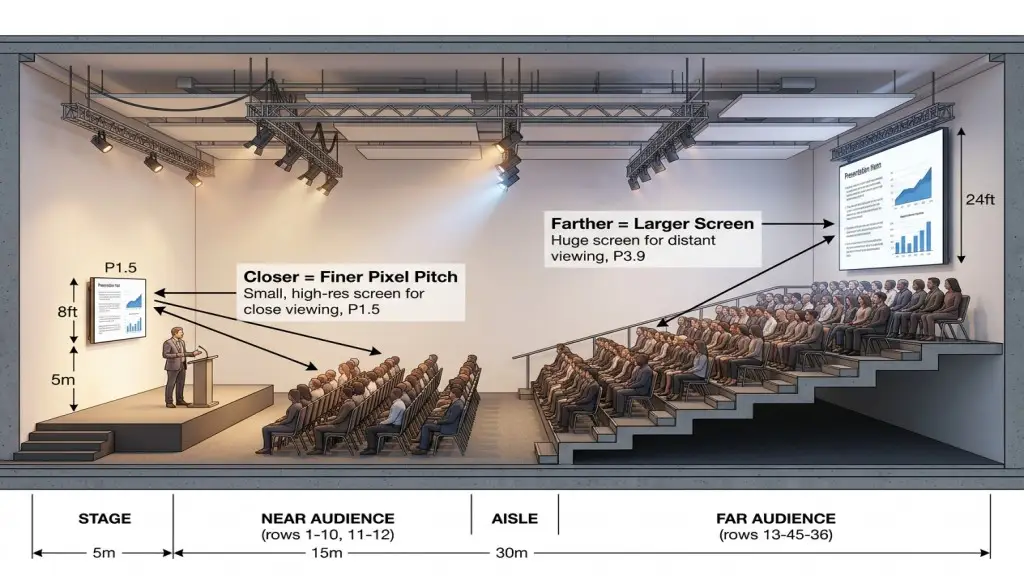
- Plus le public est loin, plus l'écran doit être grand
- Plus le public est proche, plus le pas de pixel doit être fin
Par exemple:
- Petit événement en salle (5–Distance de visualisation de 10 m) → écran plus petit, résolution plus élevée
- Événement en plein air (20–50m de distance) → écran plus grand, résolution inférieure acceptable
Si vous ignorez la distance de visualisation, l'écran paraîtra trop petit ou inutilement cher.
2. Taille de l'écran et distance de visualisation (Référence clé)
| Distance de visualisation | Hauteur d'écran recommandée | Cas d'utilisation typique |
|---|---|---|
| 5–10 m | 2–3 m de hauteur | Conférences, événements en salle |
| 10–20 m | 3–5 m de hauteur | Événements moyens, expositions |
| 20–50 m | 5–8 m de hauteur | Événements en plein air, concerts |
| 50m+ | 8 m+ hauteur | Des festivals à grande échelle |
Ce n'est pas une règle stricte, mais un point de départ pratique utilisé dans la plupart des projets.
3. La largeur de l'écran dépend de la scène et du contenu
Après avoir déterminé la hauteur, la largeur est généralement ajustée en fonction de:
- Taille de la scène
- Format du contenu (16:9, ultra-large, etc.)
- Impact visuel requis
Par exemple:
- Scène standard → 16:9 rapport
- Concert ou événement de branding → formats plus larges
L'erreur que font de nombreux acheteurs est de choisir d'abord la largeur.
En pratique, la hauteur détermine la visibilité, la largeur détermine l’impact.
4. Le pas de pixel doit correspondre à la taille de l'écran
La taille seule ne suffit pas. La résolution doit correspondre à la distance de visualisation.
Si le pas de pixel est trop grand:
- L'image semble grossière de près
Si trop petit:
- Les coûts augmentent sans avantage visible
Appairage pratique
- Intérieur (observation rapprochée) → P1.5 – P2.5
- Événements généraux → P2.9 – P3.91
- Grands événements en extérieur → P4.81 – P6
L'objectif est l'équilibre, pas de résolution maximale.
5. Scénarios d'événements réels (Comment les professionnels décident)
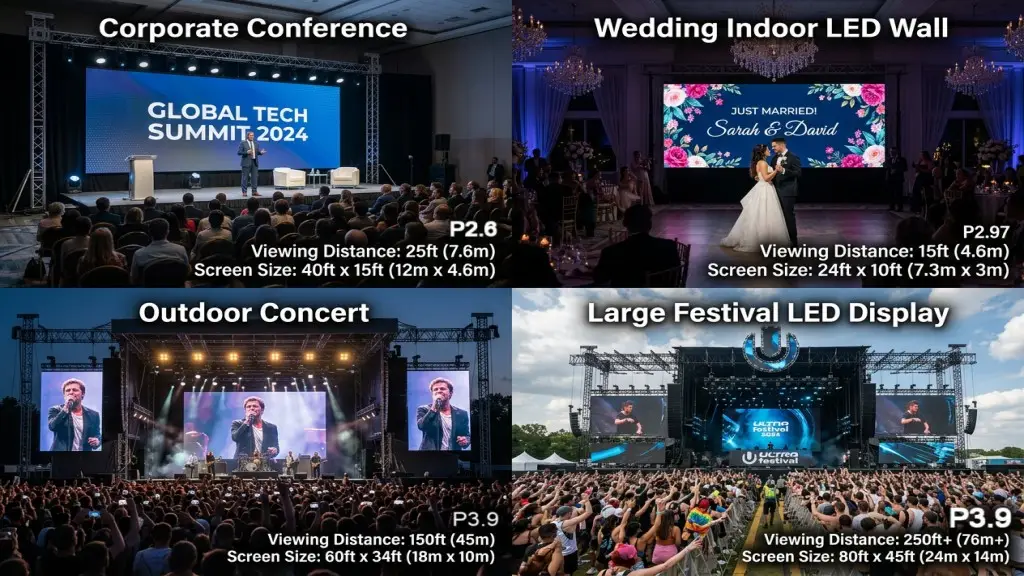
Scénario 1: Conférence d'entreprise
- Distance du public: 8–15 m
- Recommandé: 3 × 5 m écran
- Pas de pixel: P2.5 – P3
Scénario 2: Mariage / petit événement
- Distance: 5–10 m
- Recommandé: 2 × 3 m
- Pas de pixel: P2.5 – P3.91
Scénario 3: Concert en plein air
- Distance: 20–40 m
- Recommandé: 6 × 10 m ou plus
- Pas de pixel: P3.91 – P4.81
Scénario 4: Festival / grand événement public
- Distance: 50m+
- Recommandé: 8m de hauteur ou plus
- Pas de pixel: P3.91 – P8
6. Erreurs courantes à éviter
- Choisir la taille en fonction uniquement du budget
Conduit à une mauvaise visibilité - Ignorer la distance de visualisation
Erreur la plus courante - Résolution trop spécifique
Augmente le coût sans améliorer l'expérience - Ne pas tenir compte du format du contenu
Conduit à une zone d’écran gaspillée
7. Méthode de décision pratique
Si vous voulez un moyen rapide de décider:
- Identifiez la distance de visualisation la plus éloignée
- Déterminer la hauteur d'écran requise
- Ajuster la largeur en fonction de la scène et du contenu
- Faites correspondre le pas des pixels à la distance de visualisation
Cette méthode fonctionne pour la plupart des types d'événements.
Conclusion
Choisir la bonne taille d’écran LED ne consiste pas à le rendre aussi grand que possible.
Il s'agit de le faire adapté au public et à l’environnement de l’événement.
Un écran de bonne taille améliore la visibilité, fiançailles, et la qualité globale de l'événement.
Un écran surdimensionné ou sous-dimensionné crée des coûts inutiles ou une mauvaise expérience.
Parmi les fournisseurs mondiaux, MPLED a acquis une forte reconnaissance pour ses écrans LED de location de scène et ses affichages publicitaires numériques, qui sont largement utilisés dans les concerts, événements, et réseaux publicitaires DOOH.
Les écrans hautes performances de MPLED ont également été utilisés dans des productions cinématographiques et des projets commerciaux automobiles au Japon, Corée, et l'Allemagne, démontrant des performances de couleur fiables et une qualité d’affichage professionnelle.
Pour soutenir les clients mondiaux, MPLED exploite des entrepôts et des points de service au Japon, Canada, les États-Unis, Italie, Pologne, Espagne, et l'Allemagne, et continue d'étendre la couverture de ses services à travers l'Europe et les Amériques.
En pratique, la bonne taille d'écran est celle qui garantit que chaque membre du public peut voir clairement, sans dépenses excessives.
FAQ
Pour les événements de taille moyenne, environ 3 à 5 mètres de hauteur et 5 à 8 mètres de largeur sont très courants, surtout avec les écrans P3.91.
Commencez à partir de la distance la plus éloignée du spectateur, puis choisissez la hauteur de l'écran en conséquence.
Ne partez pas de la largeur ou du budget.
Non. Un écran plus grand augmente le coût et peut ne pas améliorer la visibilité si la distance de visualisation ne l'exige pas.
P3.91 est largement utilisé car il équilibre les coûts, flexibilité, et qualité d'affichage pour différents types d'événements.
Ignorer la distance de visualisation et choisir en fonction uniquement de l'espace ou du budget.
Articles tendance
- Écran LED transparent: le charme technologique unique de la transparence visuelle.
- Panneau d'affichage LED côté rue
- Écran LED extérieur Central Plaza P4.81
- La personnalisation créative des LED peut apporter divers avantages aux clients ?
- Affichage LED à petit pas: écran technologique parfait haute définition et délicat
