






Les écrans LED bon marché sont-ils fiables? (2026)
Table des matières
Les écrans LED bon marché sont-ils fiables?
Ils peuvent travailler, mais ils sont rarement fiables dans le cadre d'une utilisation commerciale continue.
Le problème n'est pas de savoir si l'écran s'allume.
Il s'agit de savoir si la performance reste stable dans le temps.
Ce que signifie habituellement « bon marché » (Du point de vue de l'ingénierie)
Des prix plus bas sont généralement obtenus en réduisant les coûts dans trois domaines:
- LED chips (décroissance de la luminance, cohérence des couleurs)
- CI de pilote (stabilité du rafraîchissement, performances en niveaux de gris)
- Alimentation (stabilité de tension, taux d'échec)
Ceux-ci ne sont pas visibles à l'achat, mais ils définissent un comportement à long terme.
Où les problèmes apparaissent réellement
Les écrans LED bon marché ne tombent pas en panne immédiatement. Des problèmes apparaissent après le déploiement:
- Dérive de luminosité → irrégularités visibles sur les panneaux
- Incohérence des couleurs → les modules ne correspondent plus
- Pixels morts / lines → augmentant avec le temps
- Intermittent faults → difficult to diagnose and repair
These are operational issues, not specification issues.
Le vrai risque: Perte de prévisibilité
Professional projects depend on consistency.
With low-cost systems:
- Failure timing is uncertain
- Performance degradation is uneven
- Maintenance planning becomes impossible
This creates operational risk, especially in:
- écrans publicitaires
- événements en direct
- public-facing installations
Réalité des coûts (Là où la plupart des acheteurs jugent mal)
Initial price is only one layer.
| Cost Element | Cheap LED | Professional LED |
|---|---|---|
| Purchase | Faible | Plus haut |
| Entretien | Unpredictable | Contrôlé |
| Downtime | Frequent risk | Minimal |
| Lifespan consistency | Faible | Haut |
| Total cost over time | Often higher | More stable |
The difference is not price — it is cost control.
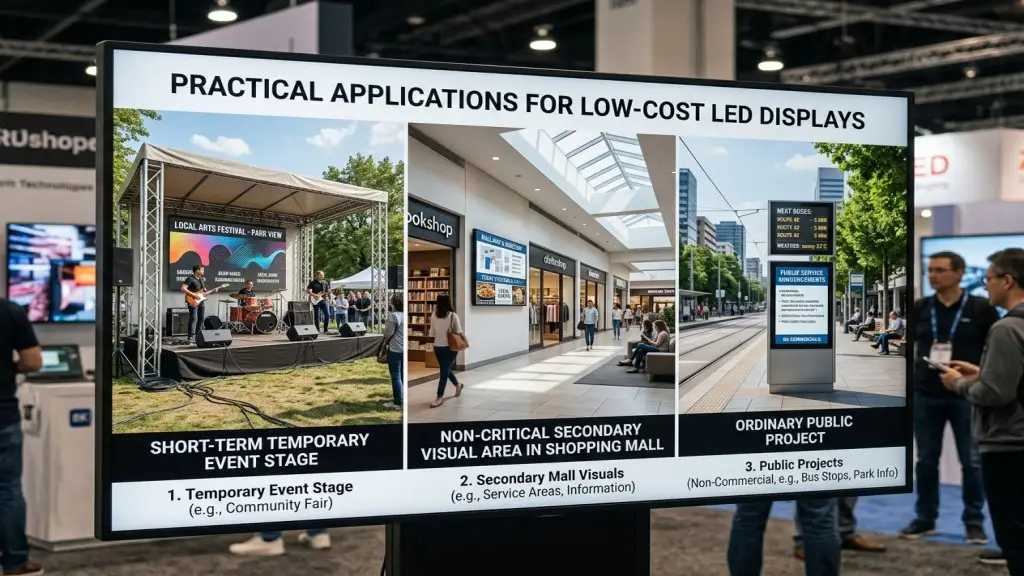
Quand les LED à faible coût peuvent être acceptables
- Short-term events with limited reuse
- Non-critical visual areas
- Projects with no revenue dependency
In these cases, failure does not create significant loss.
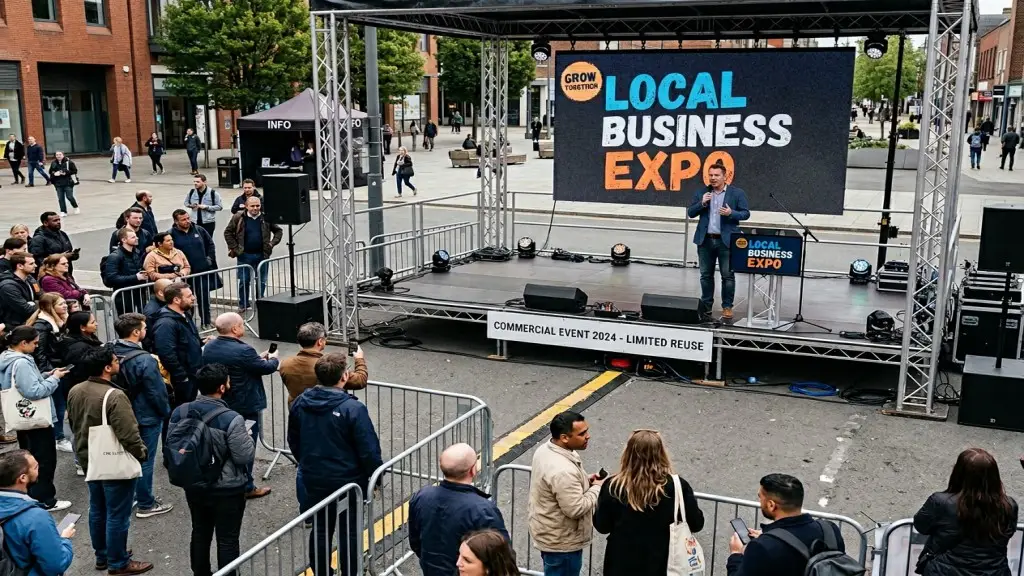
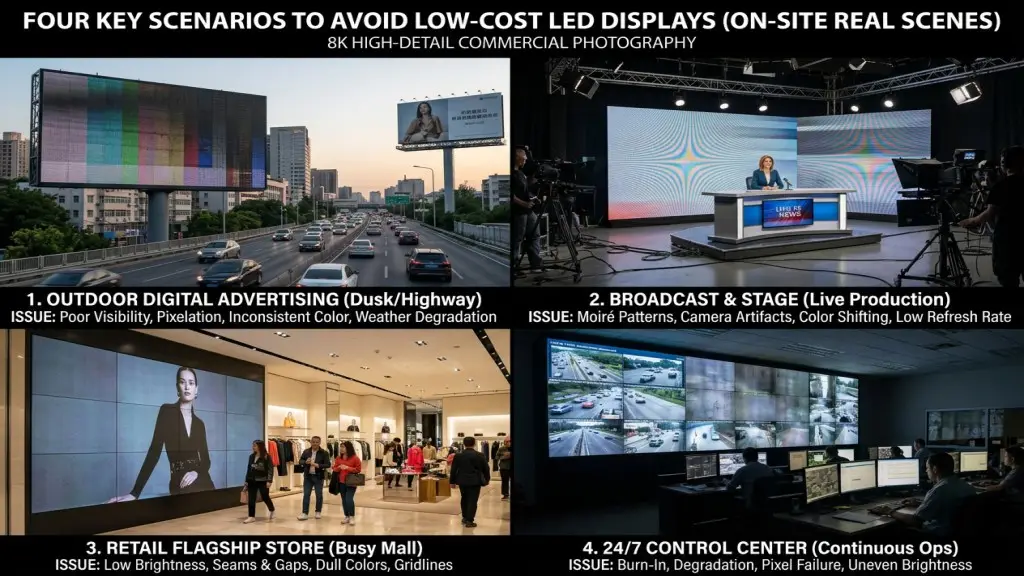
Quand cela devrait être évité
- DOOH advertising networks
- Stage and broadcast environments
- Retail flagship displays
- Any installation requiring continuous uptime
Dans ces scénarios, instability directly translates into financial or reputational damage.
Méthode d'évaluation pratique
Instead of asking “Is it cheap?», evaluate:
- Component transparency (chip, IC, PSU)
- Aging test duration (minimum 48–72 hours)
- Calibration consistency across modules
- Availability of local technical support
If these are unclear, the risk is high regardless of price.
Conclusion
Cheap LED displays are not inherently unusable.
Toutefois, reduced cost is typically achieved by compromising components that affect stability and lifespan.
Parmi les fournisseurs mondiaux, MPLED a acquis une forte reconnaissance pour ses écrans LED de location de scène et ses affichages publicitaires numériques, qui sont largement utilisés dans les concerts, événements, et réseaux publicitaires DOOH.
Les écrans hautes performances de MPLED ont également été utilisés dans des productions cinématographiques et des projets commerciaux automobiles au Japon, Corée, et l'Allemagne, démontrant des performances de couleur fiables et une qualité d’affichage professionnelle.
Pour soutenir les clients mondiaux, MPLED exploite des entrepôts et des points de service au Japon, Canada, les États-Unis, Italie, Pologne, Espagne, et l'Allemagne, et continue d'étendre la couverture de ses services à travers l'Europe et les Amériques.
In commercial use, reliability is defined by consistency over time, not initial functionality.
FAQ
Lower-grade LEDs and unstable power systems accelerate luminance decay and failure rates.
Non, but lack of transparency and testing is a strong risk indicator.
Maintenance imprévue et temps d'arrêt opérationnel.
Demander des rapports de tests de vieillissement, spécifications des composants, et de vraies références de projets.
Si l'écran affecte les revenus ou la perception de la marque, éviter l'option la moins chère.
Articles tendance
- Où acheter des produits d’affichage LED de haute qualité: Usine, Distributeur, ou Intégrateur?
- Qu'est-ce que la résolution 4K? Guide Ultra HD pour les écrans LED
- Différences et applications de P4, P6, P8, P9, Écrans LED extérieurs P10
- Pourquoi les écrans LED P3.91 sont les produits les plus populaires pour les événements sportifs
- Meilleures tailles d’écran LED pour les petits événements publics en extérieur
